
The CEO was frustrated. Revenue was growing, but something felt off. Teams were working in silos. Middle managers were overwhelmed. The culture that had fuelled the company’s early growth was cracking under the pressure of scale. The HR team had tried team-building workshops, restructured reporting lines, and launched an employee engagement survey. Nothing was working.
A colleague suggested bringing in an OD consultant. “What exactly does an OD consultant do?” the CEO asked. “And how is it different from what our HR team already handles?”
It is a question many Indian business leaders ask. Organization Development, or OD, is one of the most powerful but least understood disciplines in the corporate world. When done well, OD consulting can transform how an entire organization functions. But many companies either do not know when they need it, confuse it with HR consulting or management consulting, or bring in external help too late, after the problems have become deeply entrenched.
This article explains what OD consulting actually is, how it differs from other types of consulting, the specific situations where external OD expertise creates the most value, and how to choose the right OD consulting partner for your organization.
What Is Organization Development Consulting?
Organization Development is a planned, systematic approach to improving an organization’s effectiveness and health through the application of behavioural science knowledge and practice. Unlike management consulting, which often focuses on strategy, processes, or technology, OD consulting focuses on the human systems within an organization: how people interact, how decisions get made, how culture shapes behaviour, and how structures either enable or hinder performance.
An OD consultant does not come in with a pre-packaged solution. Instead, they work collaboratively with the organization’s leadership to diagnose underlying issues, co-create interventions that address root causes, and support the implementation of changes that improve how the organization functions as a whole.
The scope of OD is broad. It can encompass culture transformation, leadership development, change management, team effectiveness, performance management design, competency frameworks, organizational restructuring, and workforce engagement strategies. What ties all of these together is the focus on improving organizational capability through people and systems, not just processes and technology.
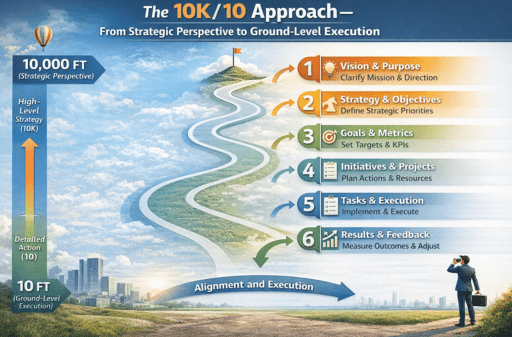
Able Ventures’ Organization Development Consulting practice follows the 10K/10 rule: developing perspective at 10,000 feet while executing with precision at 10 feet. This means understanding the big picture strategic context while ensuring that every intervention is practical, detailed, and implementable on the ground.
OD Consulting vs HR Consulting vs Management Consulting: Understanding the Difference
One of the most common sources of confusion is the overlap between OD consulting, HR consulting, and management consulting. While there are areas of intersection, each discipline has a distinct focus and methodology.
Parameter | OD Consulting | HR Consulting | Management Consulting |
Primary Focus | Improving organizational effectiveness through people systems, culture, and behaviour change | Optimizing HR functions: policies, compliance, compensation, recruitment processes | Improving business strategy, operations, and financial performance |
Core Question | How can we help this organization work better as a system? | How can we improve HR processes and compliance? | How can we increase revenue, reduce costs, or enter new markets? |
Approach | Collaborative: works with the organization to co-create solutions | Advisory: recommends best practices and process improvements | Expert-driven: analyses data and prescribes solutions |
Typical Interventions | Culture transformation, leadership development, change management, team diagnostics, competency mapping | Policy design, payroll systems, compliance audits, recruitment process outsourcing | Market entry strategy, cost optimization, digital transformation, M&A advisory |
Time Horizon | Medium to long term (6 months to 3+ years) | Short to medium term (project-based) | Short to medium term (engagement-based) |
Measurement of Success | Behavioural change, culture shift, improved organizational health metrics | Process efficiency, compliance scores, cost per hire | Revenue growth, cost savings, market share |
Who It Involves | All levels: leadership, middle management, teams, and individuals | Primarily HR function and leadership | Primarily C-suite and senior leadership |
The key distinction is this: HR consulting improves HR processes. Management consulting improves business strategy. OD consulting improves how the organization functions as a human system. In practice, the most effective transformations often require elements of all three, but OD is the discipline that addresses the people dynamics that ultimately determine whether any strategy or process change actually takes root.
12 Signs Your Organization Needs an External OD Consultant
Not every organizational challenge requires external OD expertise. Some issues can be addressed through internal HR initiatives, targeted training, or leadership action. But certain patterns indicate that the problem runs deeper than what internal resources alone can resolve.
Here are 12 situations where bringing in an external OD consultant is likely the right decision.
- Growth is outpacing your organizational design. The structures, processes, and roles that worked when you were a 200 person company are breaking down at 1,000 people. Teams are confused about accountability, decision-making is slow, and communication across functions has deteriorated.
- Employee engagement scores are declining despite multiple interventions. You have conducted surveys, launched initiatives, and invested in perks, but engagement keeps dropping. The root causes are systemic and not visible from inside the organization.
- High-performing employees are leaving. When your best people leave and cite “culture” or “growth opportunities” as the reason, it signals a deeper organizational issue that retention strategies alone cannot fix.
- A major strategic shift requires organization-wide change. Whether it is a digital transformation, a merger or acquisition, a new market entry, or a fundamental shift in business model, the organizational implications require expert change management support.
- Leadership capability is not keeping pace with business complexity. Managers who were effective in simpler times are struggling with the demands of a more complex, fast-moving environment. The organization needs a systematic approach to building leadership capability at scale.
- Teams are working in silos. Cross-functional collaboration has broken down. Departments optimize for their own goals rather than organizational outcomes. Finger-pointing has replaced problem-solving.
- Performance management feels broken. Reviews are inconsistent, goals are unclear, feedback is rare, and the performance management system is seen as a compliance exercise rather than a development tool.
- The culture has become toxic or misaligned. Behaviours that were tolerated during a different phase of the company’s life are now actively harming performance, talent retention, and the organization’s reputation.
- Internal HR does not have the bandwidth or specialized expertise. Your HR team is excellent at operational HR but does not have deep OD expertise. This is not a failure; OD is a specialized discipline that requires different skills and experience.
- You need an objective, outside perspective. Internal teams are too close to the problems and organizational politics to diagnose root causes objectively. An external consultant brings fresh eyes and the freedom to speak uncomfortable truths.
- Previous change initiatives have failed. You have tried to address organizational issues before, but the changes did not stick. This often indicates that interventions were addressing symptoms rather than systemic root causes.
- You are preparing for succession or leadership transition. When founders step back, when a new CEO takes charge, or when a generation of senior leaders approaches retirement, the organization needs a structured transition strategy.
What an OD Consulting Engagement Looks Like: The Diagnose, Develop, Deploy Framework
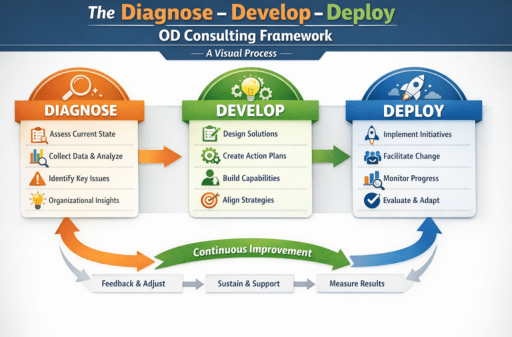
Effective OD consulting follows a structured process. While every engagement is unique, the general flow moves through three interconnected phases.
Phase 1: Diagnose
The first phase focuses on understanding the current state of the organization and its challenges through appropriate diagnostics. This involves a combination of data collection methods: stakeholder interviews with leadership and key influencers, employee surveys and focus groups, analysis of organizational data (attrition patterns, engagement scores, performance data), observation of meetings and workflows, and review of existing structures, policies, and processes.
The goal of the diagnostic phase is to move beyond surface symptoms and identify the underlying systemic factors that are driving the challenges. A rising attrition rate, for example, might be a symptom of unclear career paths, misaligned compensation, ineffective management practices, or a culture that does not support growth. The diagnosis determines which of these root causes is actually at play.
Able Ventures uses tools like behavioural assessments and team diagnostics during this phase to gather objective, data-driven insights into individual and team capabilities, providing a foundation for targeted intervention design.
Phase 2: Develop
Based on the diagnostic findings, the OD consultant co-creates interventions with the organization’s leadership. The emphasis on co-creation is important. OD is not about an external expert telling you what to do. It is about working together to design solutions that fit your specific context, culture, and constraints.
Interventions might include redesigning the organizational structure, developing a competency framework, designing a new performance management system, creating a culture transformation roadmap, building a leadership pipeline, implementing a change management strategy, or launching a workforce engagement initiative. Often, multiple interventions are required because organizational challenges are interconnected.
For organizations where culture misalignment is a core issue, Able Ventures’ Culture NXT programme provides a structured, research-backed approach to assessing and transforming organizational culture.
Phase 3: Deploy
The deployment phase is where many consulting engagements fall short. Recommendations without implementation are just expensive documents. Effective OD consulting includes hands-on support for implementing solutions, monitoring their effectiveness, and adjusting the approach based on real-world feedback.
This might involve facilitating change communication across the organization, training managers on new processes or frameworks, coaching leaders through the transition, tracking key metrics to measure intervention effectiveness, and providing ongoing support as the organization embeds the changes into its daily operations.
The implementation phase often includes targeted corporate training programmes that equip managers and employees with the skills and behaviours needed to operate effectively within the new organizational systems.
The Nine Areas Where OD Consulting Creates the Most Value
OD consulting can address a wide range of organizational challenges. Here are the nine areas where external OD expertise typically creates the most significant impact for Indian organizations.
Area of Expertise | What the Consultant Does | Business Impact |
Culture Transformation | Assesses current culture, defines desired culture aligned with strategy, designs a transformation roadmap, and supports implementation | Aligned behaviours, improved collaboration, stronger employer brand, reduced attrition |
Performance Management | Designs PMS frameworks including goal setting, KPIs, performance review mechanisms, and reward and recognition programmes | Clearer accountability, improved individual and team performance, fairer promotion decisions |
Competency Compass | Conducts competency mapping exercises to create customized competency frameworks aligned with talent development strategy | Better hiring accuracy, targeted development, stronger succession planning, clearer career paths |
Talent Strategy | Designs holistic strategies for recruitment, onboarding, career development, succession planning, high-potential identification, and workforce planning | Right people in right roles, reduced cost per hire, stronger leadership pipeline, lower attrition |
Team Diagnostics | Creates customized assessment tools to diagnose team and individual capabilities on functional and behavioural competencies | Targeted development plans, improved team effectiveness, better resource allocation |
Workforce Engagement | Designs and administers engagement surveys, creates customized engagement strategies, and develops employee wellness programmes | Higher motivation, improved job satisfaction, stronger retention, healthier workplace culture |
Compensation Benchmarking | Conducts industry-wide compensation benchmarking and develops strategies for restructuring, benefits design, and incentive programmes | Competitive compensation positioning, improved talent attraction and retention, cost optimization |
Change Management | Designs strategies to drive change through planning, communication, and training stakeholders for smooth transitions | Reduced resistance to change, faster adoption, sustained transformation outcomes |
Organisation Work Level Design | Designs organizational restructuring strategies including job analysis, job design, and role clarity initiatives | Improved efficiency, clearer decision rights, better alignment between structure and strategy |
Internal HR vs External OD Consultant: When Do You Need Outside Help?
This is a practical question that many organizations struggle with. Here is a framework for deciding when internal HR can handle a challenge and when external OD expertise is warranted.
Situation | Internal HR Can Handle | Bring in External OD Consultant |
Scope of challenge | Departmental, contained within one function | Organization-wide, cross-functional, systemic |
Root cause clarity | Clear and well understood | Unclear, contested, or deeply embedded |
Political sensitivity | Low to moderate | High; internal teams cannot speak freely |
Required expertise | Standard HR practices | Specialized OD methodologies, behavioural science |
Internal bandwidth | HR team has capacity alongside BAU work | The scale requires dedicated, focused effort beyond normal workload |
Previous attempts | First time addressing this issue | Multiple internal attempts have not produced results |
Objectivity needed | Internal perspective is sufficient | Fresh, unbiased perspective is essential for credibility |
The most effective approach is often a partnership between internal HR and an external OD consultant. The internal team brings organizational knowledge, relationships, and continuity. The external consultant brings specialized expertise, objectivity, and the ability to challenge assumptions that insiders may be too close to see.
How to Choose the Right OD Consulting Partner
Not all OD consultants are created equal. Choosing the wrong partner can waste significant time and money while failing to address the underlying issues. Here are the criteria that matter most when selecting an OD consulting firm for your Indian organization.
Deep OD Expertise, Not Just HR Generalism
Many firms that offer “OD consulting” are actually HR generalists who have added OD to their service list. True OD expertise requires a deep understanding of behavioural science, systems thinking, organizational psychology, and change management methodology. Ask about the theoretical foundations of their approach and the qualifications of their consulting team.
End-to-End Implementation, Not Just Recommendations
A consulting firm that delivers a beautifully designed strategy document but leaves you to implement it alone is not providing OD consulting. Look for a partner that stays with you through the entire journey: from diagnosis through design through deployment and measurement. The real value of OD consulting is in the implementation, not the presentation.
Able Ventures differentiates itself precisely on this point. Their OD consulting approach is built on the principle of not just design, but end-to-end implementation, ensuring that interventions are executed on the ground and produce measurable outcomes.
Proven Track Record in Indian Organizations
OD interventions must account for the unique dynamics of Indian workplaces: hierarchical structures, relationship-driven cultures, the balance between individual and collective orientations, and the pace of change in rapidly growing Indian companies. A consulting partner with extensive experience in the Indian context will design interventions that work within these realities rather than against them.
Assessment Capability
Effective OD consulting requires robust diagnostic tools. A partner that combines qualitative diagnosis with data-driven gamified behavioural assessments and structured
learning assessments provides a much richer and more objective foundation for intervention design than one that relies solely on interviews and surveys.
Integration Across Development and Training
OD interventions often require supporting elements like leadership development, skills training, and culture reinforcement. A partner that can deliver these connected capabilities within a single, coherent strategy is far more effective than one that focuses on diagnosis alone.
Able Ventures’ integrated approach connects OD consulting with leadership development programs,
structured learning journeys, and
professional development programmes, creating a comprehensive ecosystem that supports organizational transformation at every level.
What to Expect from an OD Consulting Engagement: A Practical Timeline
OD is not a quick fix. Genuine organizational transformation takes time. Here is a realistic timeline framework for what organizations can expect.
Phase | Typical Duration | Key Activities | Expected Outcomes |
Discovery and Scoping | 2 to 4 weeks | Initial meetings, scope definition, stakeholder alignment, engagement design | Clear project charter, agreed objectives and success metrics |
Diagnosis | 4 to 8 weeks | Data collection, stakeholder interviews, assessments, analysis, findings presentation | Root cause clarity, prioritized areas for intervention |
Intervention Design | 4 to 6 weeks | Co-creation workshops, intervention design, implementation roadmap | Detailed intervention plan with timelines, resources, and accountability |
Implementation | 3 to 12 months | Phased deployment of interventions, training, communication, change support | Visible shifts in behaviours, processes, and systems |
Measurement and Embedding | Ongoing (3 to 6 months post-deployment) | Impact measurement, feedback loops, refinement, transfer to internal team | Sustained change, measurable improvement in organizational health metrics |
Total engagement duration typically ranges from 6 months to 2 years depending on the scope and complexity of the organizational challenges being addressed.
Common Mistakes Organizations Make When Engaging OD Consultants
- Bringing in a consultant too late. Organizations often wait until problems become crises before seeking external help. Early intervention is more effective, less costly, and less disruptive.
- Treating OD consulting as a project rather than a partnership. OD works best when the consultant is a trusted partner embedded in the organization’s change journey, not a vendor delivering a one-time project.
- Expecting instant results. Culture change, behaviour change, and systems change take time. Organizations that expect transformation within 60 days will be disappointed.
- Not involving leadership actively. When senior leaders delegate OD to the HR team without their own active participation, the engagement loses credibility and the interventions lack the authority needed for organization-wide adoption.
- Choosing based on cost alone. The cheapest OD consultant is rarely the most effective. The cost of a failed engagement is far greater than the difference in consulting fees.
- Skipping the diagnostic phase. Some organizations want to jump straight to solutions. Without a thorough diagnosis, interventions often address the wrong problems.
The ROI of OD Consulting: How to Measure Impact
Measuring the return on OD consulting can feel challenging because the outcomes are often qualitative, such as better collaboration, stronger culture, or improved leadership effectiveness. However, these outcomes do translate into measurable business metrics.
- Employee engagement scores. Tracked through regular surveys before, during, and after the intervention.
- Attrition rates. Especially voluntary attrition among high performers and critical roles.
- Time to fill and quality of hire. Improved employer brand and clearer role design reduce both.
- Manager effectiveness scores. Measured through 360 feedback and team performance data.
- Cross-functional project success rates. An indicator of improved collaboration and reduced silo behaviour.
- Performance distribution. Shift in the bell curve toward higher performance ratings over time.
- Business outcomes. Revenue per employee, customer satisfaction, operational efficiency, all of which are influenced by organizational health.
Organizations that combine OD consulting with communication skill development initiatives and targeted training often see compound effects, where improvements in one area accelerate progress in others.
Similarly, integrating OD insights with e-learning solutions enables organizations to scale capability-building interventions across geographically distributed teams, multiplying the reach and impact of the OD engagement.
Final Thoughts
Organization Development consulting is not a luxury. For Indian organizations navigating rapid growth, digital transformation, talent competition, and cultural complexity, it is an essential capability. The question is not whether your organization can afford OD consulting. It is whether your organization can afford to keep solving symptoms while the underlying systemic issues continue to erode performance, culture, and talent retention.
The right OD consulting partner does not just diagnose problems. They work alongside you to build the organizational capability and health that enables sustained high performance. They do not deliver recommendations and leave. They stay, implement, measure, and refine until the changes are embedded and the organization is stronger.
If your organization is facing the kind of challenges that go deeper than training or process improvement can solve, explore how Able Ventures’ Organization Development Consulting services can help you diagnose root causes, design targeted interventions, and deploy solutions that drive measurable, lasting improvement.


How to Design a Competency Framework: An 8-Step Practitioner Guide for Indian Organisations
In our experience working with mid-size Indian organisations across BFSI, manufacturing, IT services, and pharma, the most

How to Train Internal Assessors in Organisations
Here is a problem that repeats itself in organisations of every size. An HR team invests three
Competency Mapping for Leadership Roles: A Step-by-Step Framework
Here is a problem that repeats itself in organisations of every size. An HR team invests three