Table of Contents
Building Future-Ready Teams: How Learning Assessment Identifies Skill Gaps Before They Hurt Performance

- February 25, 2026
- Dinesh Rajesh
- 12:25 pm
There is a moment in every organization’s growth trajectory when the gap between the skills employees currently possess and the skills the business actually needs becomes impossible to ignore. It usually arrives not as a slow realization but as a sudden, expensive shock. A product launch stumbles because the team lacked data analytics capabilities nobody thought to measure. A key account churns because the relationship managers were never assessed for consultative selling competencies. A digital transformation stalls because the technical workforce’s cloud readiness was assumed, not verified.
The common thread in each of these scenarios is the same: nobody measured the skill gap before it became a performance crisis. And that is precisely the problem that learning assessment solves.
At its core, learning assessment is the discipline of systematically measuring what your workforce can and cannot do today, comparing that reality against what the business will need them to do tomorrow, and using the difference to drive precise, accountable development investments. It transforms the L&D function from a cost centre that delivers training programmes based on intuition into a strategic capability that builds workforce readiness based on evidence.
For L&D heads and workforce planning teams in Indian organizations, mastering learning assessment is no longer optional. In an environment where skill requirements shift faster than annual training calendars can accommodate, the ability to identify, quantify, and close skill gaps proactively is the difference between building future-ready teams and reacting to capability failures after the damage is done.
This article provides a comprehensive strategic framework for using learning assessment to identify skill gaps before they hurt performance, covering the methodology, the implementation process, common pitfalls, and the measurable business impact you can expect.
The Hidden Cost of Unidentified Skill Gaps in Indian Organizations
Most Indian organizations dramatically underestimate the cost of skill gaps because they only count the visible consequences: failed projects, lost clients, missed deadlines. The invisible costs, the ones that compound silently over months and years, are far larger.
Direct Performance Costs
When employees lack critical skills for their roles, productivity does not just decline marginally. It cascades. A manager who lacks data interpretation skills makes slower, worse decisions. Those decisions create rework for the team. The rework delays deliverables. The delayed deliverables frustrate clients. The frustrated clients escalate. The escalation consumes senior leadership time. What began as a single competency gap in one manager ends up costing the organization across multiple dimensions.
Research from Indian IT services firms suggests that unidentified technical skill gaps reduce project margins by 15 to 25% on average. In manufacturing, operational skill gaps correlate with 20 to 35% higher quality defect rates. In sales organizations, consultative selling skill gaps are linked to 30 to 40% longer deal cycles and significantly lower win rates on complex accounts.
Wasted Training Investment
Without precise skill gap data, organizations default to broadcasting generic training programmes at entire populations. The mid-level managers who already possess strong presentation skills sit through the same communication workshop as managers who genuinely need it. The result: 40 to 60% of corporate training spend is estimated to be wasted on programmes that target the wrong people, address the wrong skills, or solve problems that do not actually exist.
This is why learning assessment is the foundation of effective corporate training. Without assessment data telling you exactly who needs what, training investments are essentially guesswork with a budget attached.
Attrition and Engagement Costs
There is a less obvious but equally damaging consequence: employees who are aware of their own skill gaps but see no organizational effort to address them become disengaged. They feel stuck. High performers, the ones with the self-awareness to recognize their own development needs, are precisely the ones who will leave for organizations that invest in closing those gaps. Replacing a high performer at middle management level costs 1.5 to 2.5 times their annual compensation.
What Learning Assessment Actually Measures (And What It Does Not)
There is a persistent confusion in Indian HR circles between learning assessment and performance appraisal. They are not the same thing, and conflating them leads to fundamentally flawed development strategies.
Performance appraisal looks backward. It evaluates what an employee achieved over a defined period. It answers the question: did this person meet their targets?
Learning assessment looks forward. It measures what an employee can do right now, compares it against what they will need to do, and quantifies the gap. It answers the question: is this person ready for what comes next?
The Four Dimensions of Learning Assessment
- Knowledge assessment: Does the person know the relevant concepts, frameworks, and information required for current and future role demands? Knowledge assessment measures declarative understanding: what someone knows they know.
- Skill assessment: Can the person actually apply their knowledge in realistic work situations? Skill assessment measures demonstrated capability under standardized conditions, not self-reported competence.
- Behavioural assessment: Does the person consistently exhibit the behaviours that drive performance in their role? Behavioural patterns like collaboration, initiative, conflict resolution, and adaptability are measured through structured observation or multi-rater feedback.
- Learning agility assessment: How quickly and effectively does the person acquire new skills when faced with unfamiliar challenges? This dimension predicts future development speed and is critical for workforce planning in rapidly evolving industries.
When all four dimensions are measured together, you get a comprehensive capability profile that reveals not just where someone stands today, but how quickly they can reach where the business needs them to be. This is where behavioural assessment becomes essential, because it captures the competency patterns that knowledge tests and self-assessments systematically miss.
Learning Assessment vs Other Measurement Approaches
|
Approach |
What It Measures |
Time Orientation |
Primary Use |
Identifies Gaps? |
Drives Targeted Development? |
|
Learning Assessment |
Current capability vs future requirement |
Forward-looking |
Workforce readiness, L&D planning |
Yes, precisely |
Yes, directly |
|
Performance Appraisal |
Past results and goal achievement |
Backward-looking |
Compensation, promotion decisions |
Indirectly |
No, too generic |
|
Training Evaluation (Kirkpatrick) |
Reaction, learning, behaviour, results |
Post-training |
Training programme effectiveness |
No |
No, evaluates past training |
|
Employee Self-Assessment |
Self-perceived competence |
Current snapshot |
Development conversations |
Unreliable (Dunning-Kruger) |
No, biased inputs |
|
Competency Mapping |
Role requirements definition |
Static framework |
Job design, hiring criteria |
Defines what to measure, not the gap |
Provides framework only |
|
Gamified Assessment (EZYSS) |
3,000+ behavioural data points per person |
Real-time, forward-looking |
Hiring, development baseline, team diagnostics |
Yes, with granular precision |
Yes, feeds personalized learning paths |
Discover Your Workforce's Hidden Skill Gaps with Learning Assessment
The Five-Stage Learning Assessment Framework for Identifying Skill Gaps
Stage 1: Strategic Capability Mapping
Every effective learning assessment begins not with employees but with the business. The first step is translating business strategy into specific capability requirements. This means answering questions like: What does our three-year strategy require our workforce to be able to do that they cannot do today? What capabilities will become critical as we expand into new markets, adopt new technologies, or serve new customer segments? Which capabilities are table stakes (everyone needs them) and which are differentiating (the ones that give us competitive advantage)?
This strategic translation work often benefits from OD consulting support because it requires a clear-eyed view of organizational capability that internal teams sometimes struggle to maintain objectively. An OD consultant can help separate genuine strategic skill requirements from the aspirational competency lists that many organizations mistake for actual planning.
The output of Stage 1 is a strategic capability map: a structured document that lists the specific capabilities required at each level of the organization, weighted by strategic importance and urgency.
Stage 2: Assessment Design and Method Selection
With the capability map in place, the next step is designing assessment instruments that can reliably measure each capability dimension. The critical principle here is: match the assessment method to what you are measuring.
- For knowledge and technical skills: Structured tests, scenario-based questionnaires, and technical simulations provide objective measurement with high scalability.
- For interpersonal and leadership behaviours: Gamified assessments, 360-degree feedback instruments, and structured behavioural observations capture the nuanced patterns that written tests miss.
- For learning agility: Novel problem-solving exercises and unfamiliar scenario simulations reveal how quickly individuals adapt and acquire new capabilities under pressure.
For organizations seeking assessment approaches that combine depth of insight with scalability and engagement, EZYSS gamified assessment offers a powerful solution. By capturing over 3,000 behavioural data points per participant through interactive, game-based scenarios, EZYSS provides the granular capability data that traditional questionnaire-based assessments cannot deliver, with completion rates above 95%.
Stage 3: Baseline Measurement
Stage 3 is where you execute the assessment across your target population. The goal is to create a precise, data-driven baseline of current workforce capability against the strategic requirements defined in Stage 1.
Several execution principles matter here. First, assessment conditions must be standardized across all participants. Second, the assessment must feel relevant and fair to participants, not punitive. Third, data collection must be comprehensive enough to produce statistically meaningful results while being practical enough to complete within reasonable timeframes. Fourth, confidentiality protocols must be clear: participants need to understand how their data will be used and, equally important, how it will not be used.
The output of Stage 3 is a workforce capability baseline: individual-level capability profiles that aggregate into team-level, function-level, and organization-level capability maps.
Stage 4: Gap Analysis and Prioritization
With the baseline established, the gap analysis compares current capability against required capability at every level. But the critical strategic step is prioritization. Not all skill gaps are equally urgent or important.
A practical prioritization framework evaluates each identified gap across three dimensions:
- Strategic impact: How much does this gap affect the organization’s ability to execute its core strategy? A digital transformation capability gap that threatens the entire business model scores higher than a presentation skill gap that affects meeting quality.
- Time sensitivity: How soon will this gap create visible performance problems? A compliance knowledge gap that could result in regulatory penalties next quarter is more urgent than a leadership competency gap that will matter in 18 months.
- Closure feasibility: How realistically can this gap be closed through development interventions? Some gaps (deep technical expertise, learning agility) take years to close. Others (specific tool proficiency, process knowledge) can be addressed in weeks.
The intersection of these three dimensions produces a prioritized gap closure roadmap that ensures development resources are allocated where they will produce the most strategic value in the shortest timeframe.
Stage 5: Development Integration and Reassessment
Assessment without action is academic. Stage 5 connects gap analysis directly to development interventions. Each prioritized skill gap gets mapped to a specific development pathway: learning journeys for comprehensive capability building, targeted workshops for specific technical skills, coaching for behavioural development, and on-the-job stretch assignments for learning agility.
Critically, Stage 5 also schedules reassessment at defined intervals (typically 3 to 6 months post-intervention) to measure whether the gap has actually closed. This reassessment loop transforms learning assessment from a one-time diagnostic into a continuous capability management system that proves the ROI of every development rupee invested.
Seven Failure Patterns That Undermine Skill Gap Identification
- Relying on self-assessment as the primary data source. Self-assessment is consistently the least reliable method of skill gap identification. Research on metacognitive bias (the Dunning-Kruger effect) demonstrates that people who lack a skill are also the worst judges of whether they possess it. Low performers overestimate their capabilities; high performers underestimate theirs. Organizations that rely on self-assessment for development planning systematically undertrain the people who need it most and overtrain those who need it least.
- Confusing activity metrics with capability data. Completing a training programme is not the same as acquiring a skill. Organizations that track course completions, certifications obtained, or learning hours logged are measuring inputs, not outcomes. Learning assessment measures what someone can actually do after the training, which is the only metric that matters for capability planning.
- Assessing too broadly, too rarely. Annual organization-wide competency assessments produce data that is simultaneously too general to drive specific development actions and too stale to reflect current reality. Effective learning assessment is role-specific, competency-targeted, and conducted at the frequency that matches the rate of change in capability requirements.
- Ignoring the gap between knowing and doing. Knowledge tests that measure whether someone understands a concept tell you nothing about whether they can apply it under real work conditions. A sales manager who scores 90% on a consultative selling knowledge test may still default to product-pushing behaviour in actual client meetings. Skill assessment must include applied, scenario-based components that measure performance, not recall.
- Treating all gaps as training problems. Not every skill gap has a training solution. Some gaps require process changes. Others require different hiring criteria. Some require organizational redesign. Learning assessment data should inform a range of interventions, not funnel every gap into the corporate training catalogue.
- Failing to connect individual gaps to team and organizational capability. Individual skill gap data becomes strategically powerful only when it is aggregated to reveal team-level and organizational-level patterns. A scattered collection of individual development plans does not constitute a workforce capability strategy. Learning assessment must produce multi-level insight.
- No reassessment loop. Without post-intervention reassessment, you have no evidence that development investments actually closed the gaps they targeted. The reassessment loop is what converts learning assessment from a diagnostic exercise into a strategic capability management system.
Reactive vs Proactive Skill Gap Management
Dimension | Reactive Approach (Most Organizations) | Proactive Learning Assessment Approach |
Gap Detection | Gaps discovered when performance fails (missed targets, client complaints, quality defects) | Gaps identified through structured assessment before performance impact |
Data Source | Manager opinions, self-assessments, anecdotal feedback | Multi-method assessment data (knowledge tests, behavioural observation, gamified assessment, 360-degree feedback) |
Training Trigger | Manager requests training when problems are already visible | Assessment data triggers targeted development before problems emerge |
Development Targeting | Broad-based programmes for entire populations | Precision-targeted interventions for specific individuals on specific competencies |
ROI Measurement | No baseline exists; ROI cannot be calculated | Pre-assessment provides baseline; post-assessment proves capability improvement and ROI |
Speed of Response | Months between problem identification and training delivery | Development pathways triggered immediately by assessment data |
Strategic Alignment | Training catalogue driven by vendor offerings and employee preferences | Development investments driven by strategic capability requirements |
Typical Training Waste | 40 to 60% of spend wasted on wrong people or wrong skills | Less than 15% waste; every intervention addresses a validated gap |
Build a Science-Based Talent Assessment System for Your Organization
The Business Impact: What Behavioural Assessment Delivers in Measurable Terms
The financial case for behavioural assessment is compelling. Here is what the evidence shows across Indian organizations that have implemented systematic behavioural assessment.
- Hiring quality improvement: Organizations report 35 to 50% reduction in first-year turnover among assessed hires versus non-assessed hires. With replacement costs averaging 1.5 to 2 times annual salary, this translates directly to significant cost savings.
- Promotion success rates: Internal promotion success rates improve from 40 to 60% (when based on performance history alone) to 75 to 85% (when supported by behavioural assessment of next-level readiness). Each avoided failed promotion saves the cost of re-hiring, team disruption, and lost productivity.
- Time-to-productivity: Assessed hires reach full productivity 25 to 40% faster because their behavioural fit with the role has been validated. Managers spend less time compensating for capability mismatches.
- Diversity improvement: Structured, objective assessment processes reduce unconscious bias in selection decisions. Organizations consistently report improved diversity metrics after implementing behavioural assessment, particularly in leadership selection.
- Succession pipeline strength: When behavioural assessment is integrated into succession planning, organizations develop significantly more ready-now internal successors for critical roles, reducing dependency on expensive and risky external hires.
- Candidate experience and employer brand: Modern assessment approaches, particularly gamified assessments, produce positive candidate experience scores that strengthen employer brand. Candidates who experience a professional, engaging assessment process form stronger impressions of the organization, even those who are not selected.
Implementation Roadmap: Getting Started with Behavioural Assessment
Phase 1: Foundation (Months 1 to 3)
Begin with a focused pilot. Select 2 to 3 high-impact roles where the cost of a wrong hiring or promotion decision is significant. Engage OD consulting support to develop role-specific competency models based on empirical analysis of what differentiates top performers. Design assessment processes matched to decision context.
Phase 2: Pilot and Validate (Months 4 to 8)
Run the behavioural assessment process in parallel with your existing approach for the selected roles. Compare assessment predictions against actual outcomes. Use validation data to refine competency models, adjust assessment methods, and calibrate scoring rubrics. This parallel approach provides evidence for the business case while minimizing transition risk.
Phase 3: Scale and Integrate (Months 9 to 18)
Expand behavioural assessment to additional roles and decision types based on pilot evidence. Integrate assessment data into your broader talent management ecosystem, connecting it to learning journeys for development planning, succession assessment, and performance management. Build internal assessment capability through assessor training and certification.
Phase 4: Optimize and Embed (Ongoing)
Continuously validate and refine assessment processes based on outcome data. Build a culture where evidence-based talent decisions are the norm rather than the exception. Leverage assessment data for workforce planning, organizational design, and strategic talent investment decisions.
The Assessment Ecosystem: How Behavioural Assessment Connects to Broader People Strategy
Behavioural assessment delivers maximum value when it is integrated into a comprehensive people development ecosystem. Here is how each component amplifies the impact.
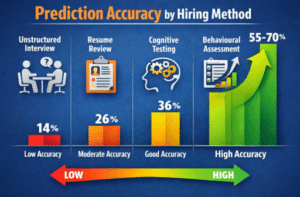
Hiring and Promotion: Behavioural assessment provides the predictive data that transforms talent selection from subjective guessing to evidence-based decision-making, improving accuracy from 14-18% to 55-70%.
Gamified Innovation: EZYSS gamified assessment captures 3,000+ behavioural data points per participant with 95%+ completion rates, providing unprecedented depth of insight while delivering an engaging candidate experience.
Development Targeting: Assessment data feeds directly into professional development programme design, ensuring that training investments target actual capability gaps rather than assumed ones.
Learning Measurement: Learning assessments use the same behavioural framework to measure pre- and post-programme capability change, creating a continuous measurement loop from assessment through development to impact.
Leadership Pipeline: Leadership development programmes use behavioural assessment data to personalize development paths, accelerate high-potential readiness, and build evidence-based succession plans.
Capability Building: Corporate training becomes more effective when informed by assessment data that identifies which specific behavioural capabilities need strengthening in which populations.
Communication Effectiveness: Communication skill development programmes are personalized based on assessment data that reveals each participant’s specific communication strengths and development areas.
Cultural Alignment: Culture transformation initiatives use aggregate assessment data to understand the current behavioural culture and design targeted interventions to shift it toward the desired state.
The Bottom Line: Assessment Is a Strategic Capability, Not an HR Tool
Behavioural assessment is not just a better interview technique. It is a strategic organizational capability that fundamentally improves the quality of talent decisions. Every hiring decision, every promotion, every succession plan, and every development investment is made better when it is informed by objective, validated behavioural data.
The organizations that invest in building this capability gain a compounding advantage. Better hiring decisions reduce turnover and accelerate productivity. Better promotion decisions build stronger leadership pipelines. Better development targeting increases the ROI of every training rupee spent. Better succession planning reduces the risk of leadership gaps during critical transitions.
For talent acquisition leaders and HR decision-makers in Indian organizations, the question is no longer whether behavioural assessment works. The evidence is overwhelming. The question is how quickly you can build this capability and start making better talent decisions.
Explore Able Ventures’ behavioural assessment solutions and discover how science-based assessment can transform the accuracy, fairness, and business impact of your organization’s most critical talent decisions.
Stop Guessing About Your Team's Skill Gaps. Start Measuring.
The Business Case: What Proactive Skill Gap Identification Delivers
The financial case for learning assessment is built on three pillars: waste reduction, performance acceleration, and strategic risk mitigation.
Waste Reduction
When skill gap data drives training investments, the waste ratio drops dramatically. Organizations using pre-training assessment to target development interventions report 35 to 50% reduction in per-employee training spend, not because they train less, but because every training rupee addresses a real, validated need. For a mid-size Indian company spending INR 2 to 3 crores annually on L&D, that translates to INR 70 lakhs to INR 1.5 crores in recovered investment every year.
Performance Acceleration
Closing skill gaps before they create performance problems produces faster, more predictable business outcomes. Teams with assessment-driven development plans reach performance targets 20 to 30% faster than teams relying on generic training calendars. In project-based industries, this translates directly to improved margins, faster delivery timelines, and higher client satisfaction scores.
Strategic Risk Mitigation
Perhaps the most undervalued benefit is risk reduction. When you know exactly where your capability gaps are, you can manage the risk. You can prioritize development for critical gaps. You can adjust hiring strategies to complement internal capability. You can make informed build-versus-buy decisions for new capabilities. You can plan succession with confidence. Without assessment data, every strategic initiative that depends on workforce capability is essentially a gamble.
Organizations that integrate learning assessment with leadership development programmes see compounding returns. Assessment identifies which leadership competencies need strengthening in the pipeline. Development programmes target those specific competencies. Post-programme assessment measures the improvement. The result: a leadership pipeline that is built on evidence rather than assumption.
Implementation Roadmap: Getting Learning Assessment Right the First Time
Phase 1: Foundation and Design (Weeks 1 to 6)
Begin with strategic alignment. Work with business leaders to identify the 3 to 5 most critical capability areas where gaps pose the greatest strategic risk. Resist the temptation to assess everything at once. A focused pilot that demonstrates clear value in one high-impact area is far more effective than a comprehensive assessment that takes six months to execute and produces a report nobody acts on.
Design assessment instruments matched to each capability dimension. Combine knowledge assessments for technical skills, EZYSS gamified assessment for behavioural competencies, and structured observation protocols for applied skills. Ensure every instrument has been validated for the specific context and audience.
Phase 2: Pilot Assessment (Weeks 7 to 12)
Execute the assessment across a carefully selected pilot population (200 to 500 individuals from the targeted functions). The pilot serves multiple purposes: it validates the assessment instruments, establishes baseline capability data, identifies any logistical or communication challenges, and produces the initial gap analysis that will demonstrate the value of the approach to broader leadership.
Phase 3: Gap Analysis and Development Planning (Weeks 13 to 16)
Analyse the assessment data at individual, team, and function levels. Prioritize gaps using the strategic impact, time sensitivity, and closure feasibility framework. Map each prioritized gap to specific development interventions: professional development programmes for comprehensive capability building, targeted skill workshops for technical gaps, coaching for leadership behavioural gaps, and stretch assignments for learning agility development.
Phase 4: Development Execution (Months 4 to 9)
Deploy targeted development interventions. Track participation, engagement, and early indicators of capability improvement. For complex capability gaps, design structured learning journeys that combine multiple learning modalities (workshops, e-learning modules, peer learning, on-the-job practice, coaching) into integrated development pathways that produce sustained behaviour change, not just temporary knowledge acquisition.
Phase 5: Reassessment and Optimization (Months 9 to 12)
Conduct reassessment using the same instruments and conditions as the baseline. Compare pre-development and post-development capability scores to quantify improvement. Calculate the ROI of each development intervention based on the cost of the intervention versus the monetary value of the capability improvement delivered. Use this data to refine the assessment model, adjust development strategies, and build the business case for scaling to additional capability areas and populations.
How Learning Assessment Connects to Your Broader People Development Ecosystem
Learning assessment delivers maximum strategic value when it operates as the intelligence layer connecting all people development activities. Here is how each component amplifies the impact.
Capability Baseline: Learning assessment provides the precise, evidence-based capability data that every other development activity depends on. Without this baseline, all development investments are educated guesses.
Behavioural Depth: Behavioural assessment adds the interpersonal and leadership competency dimensions that knowledge tests cannot capture, revealing the behavioural patterns that differentiate average performers from top performers.
Gamified Precision: EZYSS gamified assessment captures 3,000+ data points per participant with 95%+ completion rates, providing the depth and engagement that traditional assessments lack.
Development Execution: Corporate training programmes become dramatically more effective when informed by assessment data that identifies exactly which skills need building in which populations.
Structured Pathways: Learning journeys use assessment data to design multi-modal development pathways that target validated gaps through the most effective combination of learning methods.
Personalized Growth: Professional development programmes are customized based on individual capability profiles, ensuring that development investments target each person’s actual growth areas.
Leadership Pipeline: Leadership development programmes use assessment data to identify which leadership competencies need strengthening in the pipeline and personalize development for high-potential individuals.
Communication Effectiveness: Communication skill development programmes are informed by assessment data revealing each participant’s specific communication strengths and development areas, making every session more relevant and productive.
Digital Learning: E-learning solutions are deployed strategically based on assessment data, targeting specific knowledge gaps that digital delivery can address most efficiently.
Cultural Alignment: Culture transformation initiatives use aggregate assessment data to understand the current behavioural culture across the workforce and design targeted interventions that shift collective capability toward the desired state.
The Bottom Line: Measure Before You Build
The most expensive skill gaps in any organization are the ones nobody measured. They compound silently. They erode performance gradually. They surface as crises that could have been prevented with a fraction of the cost that cleaning up the aftermath requires.
Learning assessment is the organizational equivalent of a comprehensive health screening. It reveals what is working, what is weakening, and what needs immediate attention, before symptoms become emergencies. Organizations that invest in systematic learning assessment build teams that are ready for what comes next, not scrambling to catch up with what already happened.
For L&D heads and workforce planning teams, the shift from reactive training to proactive capability management begins with a single decision: to stop guessing about skill gaps and start measuring them. The methodology exists. The tools are proven. The business case is overwhelming.
Explore Able Ventures’ learning assessment solutions and discover how evidence-based capability measurement can transform the precision, accountability, and strategic impact of your organization’s people development investments.
Ready to Build Future-Ready Teams? Talk to Our Learning Assessment Experts Today

Dinesh Rajesh
Frequently Asked Questions
Learning assessment is a forward-looking, structured methodology that measures what employees can currently do, compares it against what the business needs them to do, and quantifies the gap. Performance appraisal looks backward at past results and goal achievement. Learning assessment identifies capability gaps before they affect performance; performance appraisal evaluates outcomes after they have occurred. The two serve different purposes and should not be conflated.
Managers observe a limited slice of employee behaviour, primarily in familiar, day-to-day situations. Learning assessment uses standardized instruments that measure capabilities across multiple dimensions, including knowledge depth, applied skill, behavioural patterns, and learning agility, in controlled conditions that reveal gaps invisible in routine work. Additionally, multi-method assessment removes the biases (recency effect, halo effect, affinity bias) that distort manager-only evaluations.
The most effective approach combines multiple methods matched to different capability dimensions: structured knowledge assessments for technical skills, gamified assessments like EZYSS for behavioural competencies (capturing 3,000+ data points per participant), 360-degree feedback for interpersonal and leadership skills, and scenario-based simulations for applied skill measurement. No single method captures the full picture; multi-method assessment produces significantly more accurate and actionable gap data.
A focused pilot typically takes 12 to 16 weeks from design to initial gap analysis. The full implementation roadmap spans approximately 12 months: 6 weeks for foundation and design, 6 weeks for pilot assessment, 4 weeks for gap analysis and development planning, 5 months for development execution, and 3 months for reassessment and optimization. Organizations with existing competency frameworks can accelerate Phase 1 significantly.
The ROI comes from three sources: waste reduction (35 to 50% reduction in training spend on non-essential interventions), performance acceleration (teams reaching targets 20 to 30% faster), and risk mitigation (proactive identification and closure of capability gaps that would otherwise create costly performance failures). For a mid-size Indian company spending INR 2 to 3 crores annually on L&D, the recovered investment from waste reduction alone typically exceeds the cost of the assessment programme within the first year.
Gamified assessment addresses three limitations of traditional methods. First, it eliminates impression management bias because participants are engaged in game-based scenarios rather than consciously presenting their best self. Second, it captures 3,000+ behavioural data points per participant compared to the 10 to 20 data points from a typical questionnaire, providing far more granular insight. Third, completion rates exceed 95% compared to 60 to 70% for traditional assessments, producing more complete population-level data. EZYSS gamified assessment delivers these advantages across all organizational levels.
Yes, and it should be. Learning assessment provides the diagnostic data that makes existing training programmes more effective by targeting them at validated gaps rather than assumed needs. Pre-programme assessment establishes a capability baseline. Post-programme reassessment measures the actual capability improvement delivered. This pre-post measurement loop transforms training from an expense line into a provable investment with quantified returns.
Assessment frequency should match the rate of change in capability requirements. For rapidly evolving technical roles (digital, data, AI), quarterly or semi-annual assessment keeps pace with shifting skill demands. For more stable functional roles, annual assessment with targeted interim assessments for critical capability areas is usually sufficient. The reassessment loop (3 to 6 months post-development) should always be scheduled regardless of the broader assessment cadence.
Learning assessment transforms workforce planning from headcount-based forecasting to capability-based planning. Instead of asking ‘How many people do we need?’ organizations can ask ‘What capabilities do we need, where do we have them, and where are the gaps?’ This capability lens enables more strategic build-versus-buy decisions, more targeted hiring criteria, more effective succession planning, and more precise resource allocation for development investments.
Fairness is protected through four mechanisms: validated instruments (assessments are tested to ensure they measure actual job-relevant capabilities, not cultural or demographic proxies), standardized conditions (every participant experiences the same assessment under the same rules), structured scoring (predefined criteria eliminate subjective interpretation), and regular adverse impact analysis (statistical monitoring of whether outcomes differ systematically across demographic groups). Modern gamified assessments add an additional layer of fairness by reducing the impression management bias that disadvantages certain populations in traditional assessment formats.
Recent Blogs
From Classroom to Boardroom: How Structured Corporate Training Builds the Next Generation of Indian Leaders
India has a leadership problem that nobody talks about honestly. The country produces some of the world’s
The Behavioural Assessment Playbook: Using Science to Make Better Hiring and Promotion Decisions
Every hiring decision is a prediction. You are predicting that this particular person, based on what you
Professional Development Programs vs Generic Training: Why Customized Learning Wins Every Time
Indian organizations spent an estimated INR 38,000 crores on corporate training in 2025. A significant portion of