

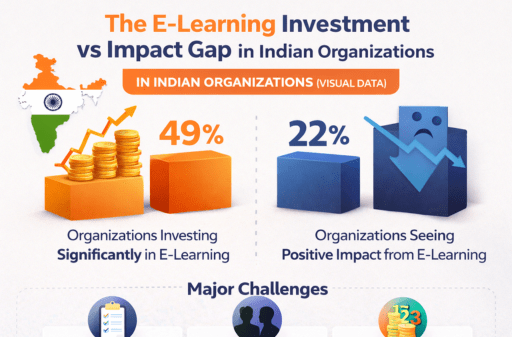
Indian organizations have embraced e-learning at a pace that few would have predicted five years ago. What was once an emergency response to remote work has become a permanent pillar of corporate learning strategy. Companies across sectors, from IT and BFSI to manufacturing and pharma, have invested in learning management systems, content libraries, and digital learning platforms.
Yet for all this investment, the results are often underwhelming. Completion rates hover in the low double digits. Learners click through modules without genuine engagement. Knowledge retention is poor. And when business leaders ask whether e-learning investments are actually improving performance, the answer is frequently unclear.
The problem is not e-learning itself. Digital learning, when designed and deployed well, can be one of the most powerful tools in an organization’s capability-building arsenal. The problem is that many Indian companies are making fundamental mistakes in how they approach e-learning, mistakes that waste budgets, frustrate learners, and produce little measurable impact.
This article identifies the 10 most common e-learning mistakes Indian companies are making in 2026 and provides practical guidance on how to avoid each one.
Mistake 1: Treating E-Learning as a Replacement for All Other Training
The most damaging mistake is positioning e-learning as the complete solution for all learning needs. After the initial cost savings of moving training online, many organizations concluded that digital learning could replace classroom training, coaching, experiential learning, and every other modality entirely.
E-learning excels at delivering foundational knowledge, scaling standardized content across geographies, providing just-in-time reference material, and reinforcing concepts introduced through other methods. It is not well suited for developing complex interpersonal skills, building leadership presence, facilitating deep behavioural change, or creating the social learning dynamics that come from face-to-face interaction.
The most effective organizations use e-learning as one component within a broader blended strategy. Corporate training programmes that combine instructor-led training with digital pre-work, post-session reinforcement through e-learning, and micro-learning nudges consistently outperform any single-modality approach.
How to avoid it: Position e-learning as a component of your learning ecosystem, not the ecosystem itself. Map each learning objective to the most appropriate modality and use e-learning where it genuinely adds value.
Mistake 2: Buying Off-the-Shelf Content Without Customization
The temptation is understandable. Off-the-shelf e-learning libraries offer thousands of courses at a fraction of the cost of custom development. Organizations purchase enterprise licenses, load the content onto their LMS, and announce the new “learning catalogue” to employees.
The result is predictable. Learners browse through generic courses that feel disconnected from their daily reality. The examples are from unfamiliar industries. The scenarios do not reflect Indian workplace dynamics. The language and cultural references feel foreign. Completion rates are abysmal because learners see no direct connection between the content and their actual work challenges.
Able Ventures’ e-learning solutions combine custom content development with instructional design expertise, ensuring every learning asset aligns with the organization’s business goals, brand guidelines, and learner expectations. From basic awareness modules to immersive simulations with AI-enabled voiceovers, content is built to fit your specific context.
How to avoid it: Use off-the-shelf content only for generic, compliance-driven topics. For anything tied to performance outcomes, invest in custom e-learning development that reflects your organization’s reality.
Mistake 3: Overloading Courses with Information Instead of Designing for Application
Many e-learning courses are essentially PowerPoint presentations converted into a digital format. Slide after slide of dense text, followed by a multiple-choice quiz that tests recall rather than application. The design assumes that exposing learners to information is the same as enabling them to apply it.
Adult learners retain and apply knowledge when they actively engage with it: making decisions in realistic scenarios, receiving feedback on their choices, and practising skills in progressively challenging contexts. Passive consumption of information, no matter how well-written, does not produce competency.
How to avoid it: Design every e-learning module around a specific performance outcome, not a list of content topics. Ask the question: “What should the learner be able to do differently after completing this module?” Then design interactive scenarios, decision points, and practice exercises that build that capability.
Mistake 4: Ignoring Mobile-First Design for a Distributed Workforce
India’s workforce is increasingly mobile and distributed. Field teams, frontline workers, retail staff, and employees in Tier 2 and Tier 3 cities often access learning primarily through smartphones. Yet many e-learning programmes are designed for desktop browsers and become unusable on smaller screens: text is too small, interactions require precise mouse clicks, and video content buffers endlessly on mobile data connections.
In 2026, mobile-first design is not optional. It is a fundamental requirement for any e-learning programme that aims to reach India’s diverse workforce. This means designing for the smallest screen first, optimizing media for low-bandwidth environments, and ensuring that every interaction works seamlessly on touch devices.
How to avoid it: Mandate mobile-first design as a non-negotiable requirement in every e-learning project. Test on actual devices across different network conditions before deploying.
Mistake 5: No Pre-Assessment to Personalize the Learning Path
Most e-learning programmes deliver the same content to every learner, regardless of their existing knowledge, experience, or skill level. A 15-year veteran goes through the same introductory modules as a recent graduate. An employee who already demonstrates the target competency is forced to complete hours of content that teaches them nothing new.
Pre-learning assessments solve this problem. Learning assessments conducted before e-learning deployment identify each learner’s current competency level, enabling the creation of personalized learning paths that skip content the learner already knows and focus on genuine development areas.
For deeper behavioural insights, gamified assessment tools like EZYSS can map individual behavioural patterns and decision-making tendencies, providing rich data that informs not just what content each learner needs but how they learn most effectively.
How to avoid it: Always conduct a pre-assessment before launching e-learning programmes. Use the results to create adaptive or tiered learning paths that respect learners’ existing capabilities.
Mistake 6: Deploying E-Learning Without Manager Involvement
The e-learning programme is assigned. Learners receive an email notification. They complete (or ignore) the modules. Their managers have no idea what was covered, no expectation to follow up, and no role in supporting application. The learning exists in a vacuum, completely disconnected from the day-to-day work environment.
Research consistently shows that manager involvement is the single strongest predictor of whether training translates into on-the-job behaviour change. When managers discuss learning goals before a programme, check in during it, and create opportunities for application afterward, completion rates and knowledge retention improve dramatically.
How to avoid it: Build a manager engagement plan into every e-learning deployment. At minimum: brief managers on the learning content, provide them with discussion questions to use with their teams, and include a post-learning conversation guide that helps managers support application.
Mistake 7: Measuring Success by Completion Rates Alone
“92% of employees completed the e-learning programme.” This is the most commonly reported metric in corporate e-learning, and it tells you almost nothing about whether the programme worked. Completion means someone clicked through to the end. It does not mean they learned anything, changed their behaviour, or improved their performance.
Effective measurement goes beyond completion to track knowledge acquisition, behaviour change, and business impact. Organizations that integrate e-learning with behavioural assessments can measure whether learners are actually applying new skills and behaviours on the job, providing meaningful data on learning effectiveness.
How to avoid it: Define success metrics that matter: knowledge retention (tested 30 days after completion), on-the-job application (observed by managers), and business impact (measured through relevant KPIs). Use completion rate as a hygiene metric, not a success indicator.
E-Learning Metrics That Matter: A Comparison
Metric Level | What It Measures | How to Measure | Why It Matters |
Completion Rate | Did learners finish the course? | LMS data: modules completed, time spent | Hygiene metric only; high completion does not equal learning |
Knowledge Retention | Did learners retain key concepts? | Delayed assessments at 30, 60, 90 days post-completion | Shows whether content was absorbed beyond the immediate session |
Engagement Quality | How deeply did learners engage? | Interaction data: scenario attempts, time on practice, replay frequency | Distinguishes genuine engagement from passive click-through |
Behaviour Application | Are learners applying skills on the job? | Manager observation, 360 feedback, behavioural assessments at 60 to 90 days | The true test of learning transfer to the workplace |
Business Impact | Did change produce measurable results? | KPI tracking: productivity, quality, customer satisfaction, error rates | Connects learning investment directly to business outcomes and ROI |
Learner Satisfaction | Did learners find the experience valuable? | Post-course surveys on relevance and applicability | Useful for design improvement, not a proxy for effectiveness |
Mistake 8: Treating E-Learning as a One-Time Event Rather Than a Journey
An employee is assigned a 45-minute e-learning module on negotiation skills. They complete it. They score 80% on the assessment. Six weeks later, they face a real negotiation and fall back on old habits because a single 45-minute digital experience cannot create lasting behaviour change.
E-learning modules are building blocks, not complete learning experiences. Able Ventures designs e-learning as part of comprehensive learning journeys that sequence digital content with live sessions, on-the-job application periods, and structured reinforcement. This multi-phase approach ensures e-learning is not an isolated event but a component of sustained capability building.
How to avoid it: Never deploy a standalone e-learning module for a skill that requires behaviour change. Always embed digital learning within a broader journey that includes practice, feedback, and reinforcement over at least 6 to 12 weeks.
Mistake 9: Neglecting Language and Cultural Localization
India has 22 official languages and a workforce that spans metropolitan hubs, emerging cities, and rural operations. Yet the vast majority of corporate e-learning content is available only in English. For frontline workers, factory teams, retail staff, and customer service teams in non-metropolitan areas, English-only content creates a significant barrier to learning.
Even among English-proficient employees, cultural localization matters. Case studies that reference Western corporate environments, examples that assume a particular cultural context, and visuals that do not reflect the Indian workplace all reduce the relevance and impact of e-learning content.
How to avoid it: Conduct a language needs analysis before developing content. For critical programmes, develop content in at least 3 to 4 regional languages in addition to English. Ensure cultural localization goes beyond translation to include relevant examples, scenarios, and visual design.
Mistake 10: No Integration Between E-Learning and Broader People Development Strategy
In many organizations, e-learning operates as a standalone function with limited connection to broader talent management, performance management, or leadership development strategies. Content is not aligned with competency frameworks. Learning paths do not connect to career progression. Assessment results do not feed into development planning.
The most effective approach integrates e-learning with the full spectrum of people development interventions: professional development programmes that define competency-based career paths,
leadership development initiatives that build capability at every management level, and
organizational culture transformation efforts that create an environment where continuous learning is valued and reinforced.
How to avoid it: Ensure your e-learning strategy is explicitly connected to your competency framework, career progression pathways, and performance management system. Every e-learning programme should have a clear line of sight to a business outcome and a development objective.
E-Learning Maturity Levels: Where Does Your Organization Stand?
Maturity Level | Characteristics | Common Mistakes at This Level | How to Advance |
Level 1: Basic (Reactive) | Compliance-driven, off-the-shelf content, LMS as repository, completion as only metric | Mistakes 2, 3, 7: generic content, information overload, completion-only measurement | Invest in custom content for high-priority topics, introduce knowledge retention assessments, conduct learning needs analysis |
Level 2: Enhanced (Structured) | Mix of custom and off-the-shelf, some interactivity, beginning to blend with ILT, basic analytics | Mistakes 4, 5, 6: poor mobile design, no pre-assessment, missing manager involvement | Mandate mobile-first design, implement pre-assessments for adaptive paths, build manager engagement protocols |
Level 3: Immersive (Strategic) | AI-enabled content, simulations, gamification, integrated with learning journeys, multi-level measurement | Mistakes 8, 9, 10: standalone modules, limited localization, weak ecosystem integration | Embed e-learning in structured journeys, localize for 3+ languages, integrate with competency frameworks and career paths |
Able Ventures’ e-learning solutions span all three maturity levels, from Level 1 Basic awareness modules to Level 3 Immersive experiences with AI-enabled voiceovers, animated simulations, and highly customizable learning elements. Organizations can start at any level and progressively upgrade as their learning maturity evolves.
What Effective E-Learning Looks Like in 2026: Five Principles
Principle 1: Design for Behaviour, Not Information
Every module should be built around a specific, observable behaviour the learner should demonstrate after completion. Scenarios, decision trees, and practice exercises form the core of the experience, with information provided as support rather than the main event.
Principle 2: Blend Intelligently
Use e-learning where it adds genuine value and combine it with live modalities for complex skill development. Communication skill development, for example, benefits from e-learning pre-work that introduces frameworks, followed by live practice sessions with real-time feedback.
Principle 3: Personalize Through Assessment
Use pre-assessments to create learning paths that respect existing knowledge and target genuine gaps. Advanced learners should skip content they already know and move directly to challenging application exercises.
Principle 4: Reinforce Over Time
A single learning event does not produce lasting change. Space learning over weeks, with micro-learning nudges, practice reminders, and reflection prompts that keep content alive long after the initial module is completed.
Principle 5: Measure What Matters
Move beyond completion rates. Track knowledge retention through delayed assessments, behaviour application through manager observation, and business impact through relevant KPIs. Use this data to continuously improve design.
How E-Learning Fits Into a Comprehensive People Development Strategy
Pre-Training Preparation: E-learning modules delivered before instructor-led corporate training sessions ensure participants arrive with a common knowledge baseline, enabling live sessions to focus on higher-order skill practice.
Post-Training Reinforcement:After live training, e-learning micro-modules delivered at spaced intervals reinforce key concepts. When integrated with structured learning journeys, this reinforcement is systematic and linked to on-the-job application goals.
Assessment and Development: E-learning assessment data, combined with behavioural and competency assessment insights, provides a comprehensive picture of each employee’s development progress, enabling targeted interventions and data-driven planning.
Organizational Development: When e-learning content is aligned with OD consulting initiatives, digital learning becomes a powerful tool for scaling new cultural behaviours and reinforcing systemic change across the organization.
The Bottom Line
E-learning is not broken. The way most Indian organizations approach e-learning is broken. When digital learning is treated as a cheap replacement for real training, loaded with generic content, deployed without assessment or manager involvement, measured by completion rates alone, and disconnected from broader development strategy, it produces the disappointing results that many organizations have come to accept as normal.
But it does not have to be this way. When e-learning is designed around behaviour outcomes, personalized through assessment, embedded within structured learning journeys, reinforced over time, and integrated into a comprehensive people development strategy, it becomes one of the most powerful and scalable tools available for building organizational capability.
If you are ready to transform your e-learning approach from a compliance checkbox to a strategic performance driver, explore Able Ventures’ custom e-learning solutions and discover how scalable, engaging, and results-driven digital learning can accelerate your organization’s capability-building agenda.


How to Design a Competency Framework: An 8-Step Practitioner Guide for Indian Organisations
In our experience working with mid-size Indian organisations across BFSI, manufacturing, IT services, and pharma, the most

How to Train Internal Assessors in Organisations
Here is a problem that repeats itself in organisations of every size. An HR team invests three

Competency Mapping for Leadership Roles: A Step-by-Step Framework
Here is a problem that repeats itself in organisations of every size. An HR team invests three