

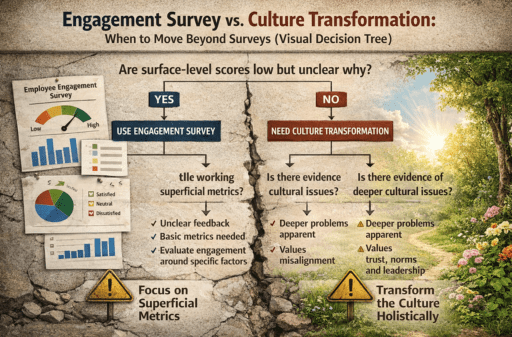
Every year, thousands of Indian organizations conduct employee engagement surveys. The results come back with neatly plotted graphs, colour-coded heatmaps, and a list of action items. HR teams create presentations. Town halls are held. A few initiatives are launched. And then, six months later, the same patterns resurface. Engagement scores remain stubbornly flat, or worse, they decline further.
Here is the uncomfortable truth: an engagement survey measures how people feel about their work environment at a given moment. It does not diagnose why the organization feels the way it does. It captures symptoms, not causes. And when the root cause is culture, no amount of survey-driven action planning will produce lasting change.
Culture is the operating system of an organization. It shapes how decisions are made, how people collaborate, how conflicts are resolved, how leaders lead, and how performance is defined and rewarded. When the operating system is broken, individual programmes and policies cannot compensate for it.
This article identifies 10 red flags that indicate your organization has moved beyond the point where engagement surveys and incremental interventions can solve the problem. If you recognize three or more of these signals, your organization likely needs a structured culture transformation, not another round of survey action items.
Red Flag 1: Engagement Survey Scores Are Flat Despite Multiple Interventions
Your organization has been running engagement surveys for three or more years. Each cycle produces a set of recommendations. HR teams implement action plans. Managers hold focus groups. New initiatives are launched. And yet the scores barely move.
This pattern is one of the clearest indicators that the problem is structural, not tactical. When multiple well-intentioned interventions fail to shift engagement, the issue is almost always cultural. The survey is capturing the downstream effects of a culture that is not working, but the action items are treating each effect as an isolated problem.
A culture transformation addresses the root system, not the individual branches. It examines the underlying beliefs, behaviours, and systems that produce disengagement, rather than trying to fix each symptom individually.
Red Flag 2: What Leaders Say and What Employees Experience Are Completely Different
Leadership talks about innovation, but every new idea gets killed by layers of approval. The website showcases values like “transparency” and “collaboration,” but employees describe a reality of information hoarding and territorial behaviour. The CEO speaks about empowerment in town halls, but middle managers operate through command and control.
This gap between the declared culture and the lived culture is one of the most damaging patterns an organization can have. Employees stop trusting leadership communication. Cynicism replaces engagement. The values on the wall become a source of dark humour rather than genuine alignment.
Bridging this gap requires more than communication workshops or leadership coaching. It requires a systematic effort to understand the current cultural reality, define the desired culture with clarity, and build a transformation roadmap that aligns leadership behaviour, systems, and practices with the declared values. This is precisely what a structured culture transformation programme is designed to accomplish.
Red Flag 3: High Performers Are Leaving and Citing “Culture” as the Reason
When your best people leave and the exit interview notes consistently mention culture, growth, or leadership as the reason, it is a signal that demands attention. High performers are typically the first to leave a deteriorating culture because they have the most options. They will not wait for the organization to figure things out.
What makes this especially dangerous is that the employees who stay are often those who have adapted to the dysfunctional culture or those who feel they have no alternatives. Over time, this creates a negative selection effect where the organization retains the people least likely to challenge the status quo or drive positive change.
Understanding why high performers leave requires more than exit surveys. It requires a diagnostic approach that examines the cultural patterns driving attrition. Behavioural assessments conducted across teams can reveal the specific cultural dynamics, such as poor feedback norms, limited growth visibility, or misaligned reward systems, that are pushing top talent out.
Red Flag 4: Departments and Teams Operate as Independent Fiefdoms
Cross-functional collaboration has broken down. Teams optimize for their own goals at the expense of organizational outcomes. Information flows vertically within departments but barely moves horizontally. When cross-departmental projects are attempted, they get stuck in territorial disputes about ownership, credit, and resources.
Silo culture is almost always a symptom of deeper organizational issues: misaligned incentives, unclear shared goals, leadership that models competitive rather than collaborative behaviour, and structures that reward departmental success over organizational success. Engagement surveys will flag collaboration as a concern, but they will not reveal why silos exist or how to dissolve them.
Breaking silo culture often requires a combination of structural changes and capability building. OD consulting interventions can diagnose the systemic factors driving silo behaviour and design integrated solutions that address structure, incentives, and leadership behaviour simultaneously.
Red Flag 5: Decision-Making Is Painfully Slow and Concentrated at the Top
Every decision, no matter how small, needs to go up the chain. Middle managers do not feel authorized to make calls within their own scope. Innovation dies because ideas have to pass through so many layers of approval that by the time they are sanctioned, the opportunity has passed. Junior employees have stopped suggesting improvements because they have learned that nothing moves without senior leadership involvement.
In Indian organizations, this pattern often gets attributed to “hierarchy,” as though it is a cultural inevitability. It is not. Hierarchy and empowerment can coexist when decision rights are clearly defined, when managers are equipped with the skills and confidence to make decisions, and when the culture rewards initiative rather than punishing mistakes.
Building a culture that balances respect for hierarchy with genuine empowerment requires a multi-layered approach. Leadership development programmes that equip managers at every level with decision-making frameworks, combined with cultural interventions that redefine what leadership looks like in practice, can transform decision-making speed without dismantling the organizational structure.
Red Flag 6: There Is a Visible “In-Group” and “Out-Group” Dynamic
Certain people always get the high-profile projects. Promotions flow to a predictable set of individuals. Access to senior leadership is reserved for a select few. Employees outside the inner circle feel invisible, regardless of their performance. Favouritism, whether based on tenure, personal relationships, or proximity to power, has replaced merit as the real currency.
In-group/out-group dynamics destroy trust faster than almost any other cultural pattern. When people believe the system is rigged, they disengage, withhold discretionary effort, and either leave or check out mentally. This is not something an engagement survey action item can fix. It requires a fundamental rethinking of how the organization defines, recognizes, and rewards contribution.
Objective, data-driven assessment tools can help break the cycle of subjective judgement. Gamified assessments like EZYSS provide unbiased behavioural data that reveals actual capabilities and potential, helping organizations make people decisions based on evidence rather than proximity or perception.
Red Flag 7: Change Initiatives Consistently Fail or Lose Momentum
The organization launches a new initiative with great energy. There are kickoff meetings, branded communications, and initial enthusiasm. Three months later, the initiative has quietly faded. People are back to doing things the old way. This happens not once but repeatedly, across different functions and different types of change.
Chronic change failure is a cultural problem, not an execution problem. It indicates that the organization’s culture actively resists change, either because people have been burned by too many failed initiatives before, because the culture rewards stability over adaptation, or because there is no sustained follow-through mechanism to embed new ways of working.
Successful change requires sustained support. Learning journeys that sequence training, application, and reinforcement over extended periods provide the sustained capability-building framework that one-off change programmes lack.
Red Flag 8: Feedback Is Absent, Superficial, or Punitive
Employees do not give honest feedback upward because they fear retaliation. Peer feedback is either absent or so sanitized that it carries no developmental value. Performance reviews are tick-box exercises where managers avoid difficult conversations. When someone does speak up with a genuine concern, the response is defensive rather than curious.
A healthy feedback culture is a cornerstone of organizational effectiveness. Without it, problems go unaddressed until they become crises, people stop learning, and leaders operate in a bubble of curated information that bears little resemblance to ground reality.
Building a genuine feedback culture requires skill development at every level. Communication skill development programmes that specifically focus on giving and receiving feedback, having courageous conversations, and creating psychological safety provide the behavioural foundation. But the cultural architecture, systems, rewards, and leadership modelling, must support the behaviour change simultaneously.
Red Flag 9: New Hires Quickly Absorb Dysfunctional Norms
You hire talented, motivated people. Within their first 90 days, they start exhibiting the same behaviours as everyone else: attending meetings without speaking up, working around dysfunctional processes rather than challenging them, and lowering their expectations of what is possible. The expression you hear most from new joiners after their first quarter is some version of “that is just how things work here.”
This is culture at its most powerful, and most dangerous. When the cultural gravity is strong enough to reshape behaviour within weeks, it confirms that the problem is systemic. The culture is not just influencing behaviour; it is overriding individual values and intentions.
Changing this pattern requires addressing the onboarding experience, manager behaviour, and the broader cultural environment simultaneously. Organizations that pair cultural transformation with structured professional development programmes create an environment where new hires are supported in maintaining the energy and fresh perspective they bring, rather than having it extinguished by cultural inertia.
Red Flag 10: The Organization Talks About Values but Has No Mechanism to Measure or Reinforce Them
Values are printed on posters, featured on the website, and mentioned in onboarding sessions. But there is no mechanism to assess whether people actually live these values. Performance reviews do not include value-based criteria. Promotions are based purely on business results, regardless of how those results were achieved. Leaders who deliver numbers but violate cultural values face no consequences.
Values without reinforcement mechanisms are aspirations at best and hypocrisy at worst. A genuine culture transformation embeds values into every people process: hiring, onboarding, performance management, promotion criteria, recognition systems, and leadership assessment. This ensures that the culture is not just declared but actively lived at every level of the organization.
Measuring values in action requires a shift from traditional assessment methods. Learning assessments that evaluate how people apply values in real scenarios, combined with competency frameworks that define what each value looks like in practice, provide the infrastructure needed to make values measurable and actionable.
Engagement Survey vs Culture Transformation: A Side-by-Side Comparison
Dimension | Engagement Survey Approach | Culture Transformation Approach |
What It Measures | Employee sentiment at a point in time | Underlying beliefs, behaviours, and systems that shape the work environment |
Depth of Diagnosis | Surface level: identifies what people feel | Root cause level: identifies why people feel that way |
Action Type | Incremental fixes: perks, policies, team events | Systemic intervention: behaviours, systems, leadership, structure |
Scope of Change | Department or function level | Organization-wide |
Time to Impact | Short-term improvement (often temporary) | Sustained change over 12 to 24 months |
Leadership Involvement | Reviews results and approves action items | Actively participates in defining and modelling the desired culture |
Impact on Behaviour | Minimal: addresses dissatisfaction without changing how people work | Transformative: redefines how decisions are made, conflicts resolved, and performance managed |
Frequency | Annual or bi-annual event | Continuous journey with structured phases |
Risk of Inaction | Survey fatigue, declining participation, cynicism | Deepening cultural dysfunction, accelerated talent loss, strategic misalignment |
Cost of Approach | Lower upfront cost, but often repeated without ROI | Higher upfront investment, but delivers measurable and sustained returns |
How Culture NXT Addresses These Red Flags: The Three-Step Transformation Framework
Able Ventures’ Culture NXT is a structured, three-step culture transformation solution designed to take organizations from cultural diagnosis through to sustained change. Unlike generic culture programmes that rely on one-size-fits-all models, Culture NXT is tailored to each organization’s specific context, challenges, and strategic aspirations.
Culture N: Discover Your Culture
The first step is understanding the current cultural reality. Using proprietary culture assessment tools, Culture N identifies the behaviours, patterns, and enablers that shape how work actually gets done today. This goes far deeper than an engagement survey. It examines the unwritten rules, the real decision-making patterns, and the cultural assumptions that drive everyday behaviour.
By establishing a shared, evidence-based view of the present state, Culture N creates the baseline required for meaningful transformation. Leaders gain clarity on where alignment exists, where gaps are emerging, and what must be addressed to enable sustainable progress.
Culture X: Visualize Your Aspirations
Culture X translates diagnostic insight into strategic intent. Through a structured facilitation methodology, leaders and teams articulate shared cultural aspirations, clarify priorities, and establish common commitments. This step ensures that the desired culture is not abstract or vague but clearly defined and collectively understood.
By aligning leadership intent with organizational realities identified in Culture N, this phase creates a focused direction for cultural change. It bridges the gap between where the organization stands today and where it needs to go.
Culture T: Transform with Intention
Culture T converts direction into disciplined execution. Using insights from Culture N and clarity from Culture X, a focused action roadmap is co-created, aligned to the organization’s business context, leadership capacity, and operational realities. Each intervention is designed to reinforce desired behaviours, decision patterns, and ways of working.
This is not a generic playbook. Culture T integrates leadership alignment, capability building, and accountability mechanisms to embed culture into everyday operations. The outcome is a culture that is not only defined and aspirational but consistently practised across the organization.
Phase | Focus | Key Activities | Red Flags It Addresses |
Culture N (Discover) | Build an evidence-based understanding of the current cultural reality | Proprietary culture assessment, behaviour pattern analysis, enabler identification, baseline creation | Red Flags 1, 2, 3, 6, 10 (sentiment gap, attrition, favouritism, values disconnect) |
Culture X (Visualize) | Define the desired culture aligned with business strategy | Structured facilitation, aspiration articulation, priority alignment, commitment building | Red Flags 2, 5, 10 (leadership alignment, decision-making clarity, values definition) |
Culture T (Transform) | Execute the transformation with structured interventions | Action roadmap co-creation, leadership alignment, capability building, accountability embedding, impact measurement | Red Flags 4, 5, 7, 8, 9 (silos, slow decisions, change failure, feedback, new hire absorption) |
Supporting Capabilities That Accelerate Culture Transformation
Culture transformation does not happen in isolation. It is most effective when supported by integrated capability-building interventions that equip people at every level to operate within the new cultural framework.
Assessment as a Foundation: Behavioural and competency assessments provide the diagnostic data needed to understand current capability levels and identify development priorities aligned with the target culture.
Training for Behavioural Shift: Corporate training programmes that are designed around the target culture behaviours, rather than generic competencies, ensure that skill development directly supports the cultural transformation journey.
Scalable Learning Infrastructure: E-learning solutions enable organizations to scale cultural learning across geographies and business units, ensuring consistent messaging and capability development regardless of location.
Sustained Development Journeys: Structured learning journeys that sequence cultural awareness, skill building, on-the-job application, and reinforcement over 12 to 16 weeks ensure that the cultural shift moves from the training room into everyday work.
The Bottom Line
Engagement surveys are useful tools. They provide a snapshot of organizational sentiment that can guide tactical improvements. But when the challenges your organization faces are structural, systemic, and deeply embedded in how people work, interact, and make decisions, an engagement survey is not enough.
If you recognized three or more of the red flags in this article, your organization has likely moved beyond the point where incremental interventions can produce meaningful change. What you need is a structured, evidence-based culture transformation that addresses the root causes of organizational dysfunction and builds the cultural infrastructure for sustained high performance.
Explore how Able Ventures’ Culture NXT transformation solution can help your organization move from cultural diagnosis to disciplined execution, creating a culture that is not just declared but consistently lived across every level of the organization.


How to Design a Competency Framework: An 8-Step Practitioner Guide for Indian Organisations
In our experience working with mid-size Indian organisations across BFSI, manufacturing, IT services, and pharma, the most

How to Train Internal Assessors in Organisations
Here is a problem that repeats itself in organisations of every size. An HR team invests three
Competency Mapping for Leadership Roles: A Step-by-Step Framework
Here is a problem that repeats itself in organisations of every size. An HR team invests three