

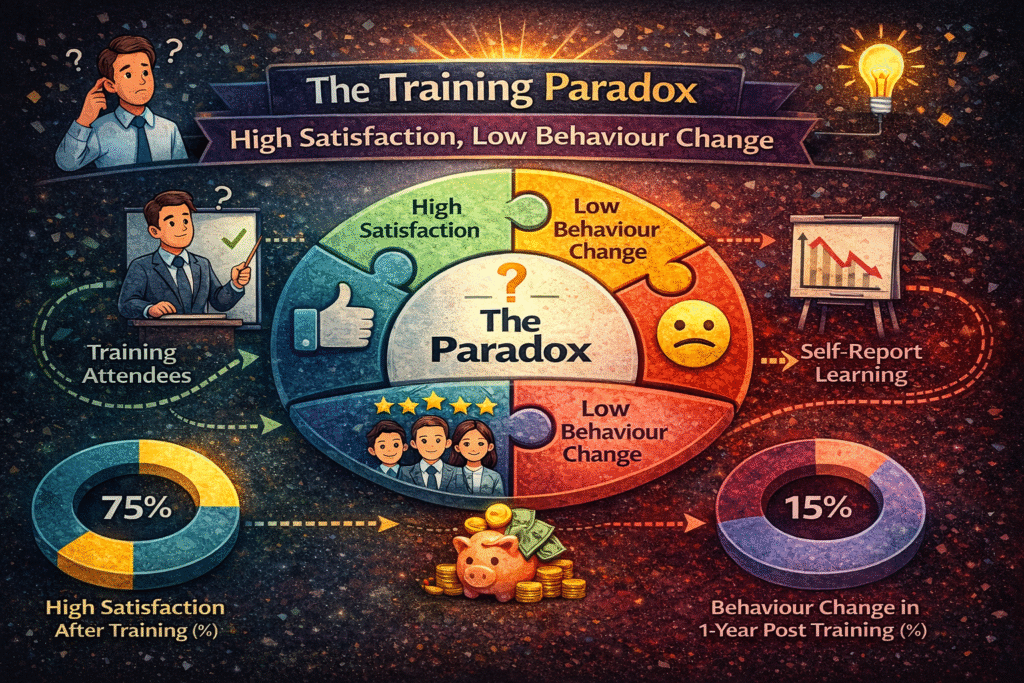
The training room was buzzing with energy. Forty managers had just completed a two-day leadership workshop. The feedback forms glowed with 4.8 out of 5 ratings. The trainer was outstanding. The case studies were engaging. Everyone left feeling inspired, motivated, and ready to lead differently.
Three months later, nothing had changed.
The managers were back to the same habits. The same meetings ran the same way. The same communication patterns persisted. The same performance gaps remained. The training budget had been spent, the compliance checkbox was ticked, and the organization had nothing tangible to show for it.
This story repeats itself in thousands of Indian organizations every year. Training events happen. Money is spent. People attend. And then the learning evaporates. It is not because the training was bad. It is not because the participants were lazy. It is because the entire approach to corporate training is designed in a way that makes behaviour change almost impossible.
This article explores the root causes of why corporate training fails to produce lasting behaviour change, and more importantly, what organizations can do differently to ensure their training investments actually transform how people work.
The Uncomfortable Truth About Corporate Training in India
India’s corporate training market is enormous and growing rapidly. Organizations across sectors, from IT and banking to manufacturing and pharma, spend heavily on employee training every year. Yet when HR leaders are asked whether training investments translate into measurable business impact, the answers are consistently unsatisfying.
The problem is not a lack of investment. It is a misalignment between how training is typically designed and delivered, and how human behaviour actually changes. Understanding this gap is the first step toward fixing it.
The Forgetting Curve Problem
Research in cognitive science has demonstrated that people forget approximately 70% of new information within 24 hours and up to 90% within a week unless that information is actively reinforced through repetition and application. This is known as the Ebbinghaus forgetting curve, and it applies to every training workshop that delivers content in a single session without structured follow-up.
When an organization conducts a two-day workshop and expects participants to retain and apply everything they learned, it is fighting against basic neuroscience. The content may have been excellent. The delivery may have been world class. But without reinforcement, the knowledge fades and the old behaviours return.
The Knowing-Doing Gap
There is a fundamental difference between knowing something and doing something. A manager can attend a workshop on coaching skills, understand the coaching framework perfectly, and score well on a post-training assessment. But doing coaching in a real conversation with a struggling team member, in the pressure of a deadline, with the habitual urge to simply give instructions, requires a completely different kind of learning.
Behaviour change requires practice in real contexts, feedback on that practice, and sustained repetition until the new behaviour becomes more natural than the old one. Most corporate training programs provide none of these elements.
Seven Reasons Why Corporate Training Fails to Change Behaviour
1. Training Is Treated as an Event, Not a Process
The single biggest reason training fails is that organizations treat it as a one-off event rather than a sustained learning process. A two-day workshop is a starting point, not a destination. Without pre-training preparation, post-training reinforcement, and on-the-job practice periods, the event remains an isolated experience disconnected from daily work.
This is precisely why organizations that shift from standalone workshops to structured learning journeys see dramatically better outcomes. Learning journeys sequence training across multiple phases, with built-in application periods and reinforcement mechanisms that combat the forgetting curve.
2. The Content Is Generic, Not Contextual
A leadership training program designed for a global audience and delivered without adaptation to the Indian corporate context will struggle to produce behaviour change. Indian workplaces have distinct dynamics around hierarchy, relationship-driven decision making, indirect communication norms, and the interplay between individual and collective cultures. When training content does not reflect these realities, participants find it intellectually interesting but practically irrelevant.
Effective training must be tailored to the organization’s industry, culture, and the specific challenges participants face in their roles. Generic programs may tick the training hours box, but they rarely change how people actually behave at work.
3. No Baseline Assessment Before Training
Most training programs launch without first measuring participants’ current competency levels. Without a baseline, there is no way to design content that addresses actual gaps, no way to personalize the learning experience, and no way to measure whether the training produced any real improvement.
Organizations that conduct behavioural assessments before training begins gain a clear picture of where each participant stands, enabling far more targeted and effective training design.
4. Managers Are Absent from the Learning Process
A participant’s direct manager is the single most important factor in determining whether training translates into on-the-job behaviour change. When managers are unaware of what their team members learned, when they do not create opportunities for practice, and when they do not reinforce new behaviours through feedback and recognition, the training essentially has no support system in the real work environment.
In many Indian organizations, managers view training as something HR organizes, not something they play an active role in. This disconnection is a major driver of training failure.
5. Post-Training Reinforcement Is Non-Existent
The workshop ends. Participants go back to their desks. Emails pile up. Deadlines loom. Within days, the urgency of daily work completely overtakes the learning from the training room. Without a structured reinforcement plan, including follow-up sessions, micro-learning nudges, coaching conversations, and practice assignments, the behaviour change journey stalls before it even begins.
6. Measurement Stops at the Feedback Form
The post-training feedback form, also known as the “happy sheet,” is the most common measurement tool in corporate training. It captures whether participants enjoyed the session and found the facilitator engaging. What it does not capture is whether participants learned anything new, changed their behaviour, or delivered better business results as a consequence.
When the only metric an organization tracks is participant satisfaction, there is no accountability for actual behaviour change, and no data to improve future training investments.
7. The Training Addresses Symptoms, Not Root Causes
Sometimes the real problem is not a skill gap at all. Poor performance might stem from unclear role expectations, dysfunctional team dynamics, misaligned incentives, or a culture that punishes the very behaviours the training is trying to build. Sending people to a communication skills workshop will not fix a culture where hierarchy suppresses honest feedback.
In these situations, what the organization needs is not more training but a deeper organization development intervention that addresses the systemic factors blocking performance.
Training That Fails vs Training That Changes Behaviour: A Comparison
|
Dimension |
Training That Fails |
Training That Changes Behaviour |
|
Design Philosophy |
Content-driven: focus on delivering information |
Behaviour-driven: focus on changing what people do on the job |
|
Duration |
One-off event (1 to 3 days) |
Multi-phase journey (6 to 16 weeks) |
|
Pre-Training |
None or minimal logistics email |
Baseline assessment, pre-learning modules, manager briefing |
|
Content Relevance |
Generic, off-the-shelf |
Tailored to organization, industry, and role context |
|
Learning Methods |
Primarily lecture and slides |
Experiential: simulations, role plays, case studies, gamified activities |
|
Manager Involvement |
None |
Active: pre-briefing, mid-point check-in, post-training reinforcement |
|
Post-Training Follow-Up |
Feedback form and certificate |
Structured reinforcement: micro-learning, coaching, practice assignments, peer learning |
|
Measurement |
Participant satisfaction (Level 1 only) |
Multi-level: knowledge, behaviour change, business impact, ROI |
|
Knowledge Retention at 90 Days |
10 to 20% |
60 to 80% |
|
Behaviour Change Rate |
Less than 15% of participants show sustained change |
60 to 75% of participants demonstrate measurable change |
|
Business ROI |
Difficult to establish; often negative |
Measurable and positive; 136%+ ROI achievable with structured approaches |
What to Do Instead: The Principles of Behaviour-Changing Training
If the goal of corporate training is genuine behaviour change, the entire approach needs to be rethought. Here are the principles that separate effective training from expensive theatre.
Principle 1: Start with a Clear Behaviour Outcome
Before designing any training content, define the specific, observable behaviours you want participants to demonstrate after the training. Not vague goals like “improve leadership skills” but precise outcomes like “conducts a structured coaching conversation with each team member at least twice per month using the GROW framework.” When the behaviour outcome is clear, every element of the training can be designed to support it.
Principle 2: Assess Before You Train
Understanding where participants currently stand is essential for designing training that addresses real gaps rather than assumed ones. Learning assessments conducted before training begins provide the baseline data needed to personalize content and set meaningful development targets.
For deeper behavioural insights, gamified assessments like EZYSS can evaluate how participants actually make decisions and respond to challenges, providing richer pre-training data than self-reported surveys.
Principle 3: Design for Practice, Not Just Knowledge
Every training session should include extensive opportunities for participants to practise the target behaviours in realistic scenarios. Role plays, simulations, live case studies, and peer feedback exercises are not add-ons to make the session more engaging. They are the core mechanism through which behaviour change happens. If participants leave a training session without having practised the target behaviour multiple times with feedback, the design has failed.
Principle 4: Build a Reinforcement Ecosystem
The real work of behaviour change happens after the training session ends. A structured reinforcement plan should include at minimum: scheduled follow-up sessions at 30, 60, and 90 days, micro-learning content delivered weekly, manager-led coaching conversations, peer accountability partnerships, and workplace application assignments with structured reflection.
This is where the right training delivery model makes a significant difference. Able Ventures’ corporate training programme offers post-program enablement through three structured tiers, Classic, Plus, and Pro, each providing escalating levels of reinforcement across 12 enablement parameters to ensure learning translates into sustained behaviour change.
Principle 5: Activate Managers as Behaviour Change Partners
Managers must be briefed on the training content, equipped with specific questions and conversation frameworks, and held accountable for supporting their team members’ development. At a minimum, every training program should include a manager engagement plan that covers: a pre-training briefing on what participants will learn, a mid-point conversation to check on application progress, and a post-training review to assess behaviour change and provide feedback.
Principle 6: Measure What Matters
Move beyond the feedback form. Implement a measurement framework that tracks at least three levels: learning (did participants acquire the intended knowledge and skills?), behaviour (are they applying it on the job?), and results (is the behaviour change producing business impact?). This requires more effort than collecting satisfaction scores, but it is the only way to know whether your training investment is working.
The TRAIN Framework: How Able Ventures Designs Training for Behaviour Change
Able Ventures has developed a proprietary approach to corporate training design that addresses the root causes of training failure. The TRAIN framework ensures that every programme is structured to drive real, sustained behaviour change.
|
TRAIN Element |
What It Means |
How It Drives Behaviour Change |
Key Features |
|
T – Tailored Solutions |
Every programme is customized to the organization’s industry, culture, and strategic priorities |
Contextually relevant content is more likely to be applied because participants see direct connections to their daily challenges |
60+ training services, 6 delivery modes (ILT, VILT, Outbound, Blended, E-Learning, Micro-learning) |
|
R – Result-Driven Approach |
Training is designed to produce measurable improvements in skills, behaviour, and business performance |
Clear behaviour outcomes are defined before training begins, and ROI is measured post-completion |
98.5% stakeholder satisfaction, 136% proven ROI on holistic training initiatives |
|
A – Accomplished Trainers |
Experienced facilitators with 15+ years of cross-industry expertise deliver every programme |
Real-world experience enables trainers to contextualize learning, making it immediately applicable to participants’ situations |
Best-fit trainer selection, strong cross-industry exposure, practical facilitation style |
|
I – Interactive & Gamified |
Experiential learning methods maximize engagement and retention |
Active participation through simulations, role plays, and gamified activities builds muscle memory for new behaviours |
Icebreakers, quizzes, gamified leaderboards, case studies, simulations, role plays |
|
N – Nimble Post-Program Enablement |
Structured reinforcement continues after the formal training ends |
Sustained reinforcement combats the forgetting curve and provides ongoing support for behaviour application |
Classic, Plus, and Pro enablement plans with 12 customizable parameters |
The TRAIN framework directly addresses each of the seven reasons training fails. Content is tailored rather than generic. Results are measured beyond satisfaction scores. Accomplished trainers bring real-world credibility. Interactive methods ensure practice, not just knowledge transfer. And nimble post-program enablement provides the reinforcement structure that most training programmes completely lack.
Delivery Models That Support Behaviour Change
The method through which training is delivered has a significant impact on whether behaviour change occurs. Different situations call for different delivery approaches, and the most effective training strategies use a blend of multiple models.
|
Delivery Model |
Best Suited For |
Behaviour Change Strength |
Limitation to Address |
|
Instructor-Led Training (ILT) |
Complex skills requiring deep discussion, role play, and live feedback |
Highest impact for interpersonal skills, leadership behaviours, and team dynamics |
Limited reach; requires physical attendance and scheduling coordination |
|
Virtual Instructor-Led Training (VILT) |
Remote and hybrid teams needing interactive, expert-led sessions |
Strong for knowledge building and discussion-based learning; moderate for skill practice |
Digital fatigue with long sessions; works best in 90-minute modules |
|
Outbound Programs |
Team building, trust development, leadership presence, problem solving |
Powerful for shifting mindsets and breaking habitual patterns through novel environments |
Impact fades without structured post-outbound reflection and workplace application |
|
Blended Programs |
Comprehensive skill development requiring multiple touchpoints |
Combines strengths of multiple models; strongest overall approach for sustained behaviour change |
Requires careful design to ensure coherence across different learning modes |
|
E-Learning |
Scalable knowledge delivery, pre-training preparation, and refresher content |
Effective for building foundational knowledge that enables behaviour change in subsequent live sessions |
Limited for interpersonal skill development; best used as part of a blended strategy |
|
Micro-Learning |
Post-training reinforcement, just-in-time learning, spaced repetition |
Excellent for reinforcing specific behaviours through regular, bite-sized nudges |
Not sufficient as a standalone method; most effective as a reinforcement layer |
Able Ventures’ e-learning solutions integrate seamlessly with instructor-led and blended programmes, providing the digital infrastructure needed for pre-training preparation, self-paced learning, and post-training reinforcement across geographically distributed teams.
The Role of Assessment in Making Training Effective
Assessment is not just something that happens at the end of training. When used strategically, assessment becomes a powerful driver of behaviour change at every stage of the training process.
Before Training: Diagnostic Assessment
Pre-training assessments identify actual competency gaps and behavioural patterns, enabling training design that targets real needs rather than assumed ones. This is where many organizations save the most money, because it prevents them from investing in training that addresses the wrong skills.
During Training: Formative Assessment
In-session assessments, including skill demonstrations, simulations, and peer evaluations, provide real-time feedback that helps participants adjust and improve their approach while the learning is still fresh.
After Training: Impact Assessment
Post-training assessments conducted at 30, 60, and 90 days measure whether participants are applying new behaviours on the job and whether those behaviours are producing measurable business results.
Organizations that integrate behavioural and competency assessments into their training strategy create a closed-loop system where assessment data informs training design, training builds targeted capabilities, and post-training assessment confirms the impact.
Building a Culture That Supports Behaviour Change
Even the best designed training programme will fail if the organizational culture works against the behaviours being developed. A company that trains managers in coaching skills but rewards only short-term results is sending conflicting signals. An organization that invests in communication training but maintains a culture where challenging senior leaders is discouraged will see limited behaviour change regardless of how good the training is.
This is why the most progressive organizations pair their training investments with broader culture transformation initiatives that align systems, processes, rewards, and leadership behaviour with the capabilities being developed through training.
When training is supported by the right cultural environment, the results compound. Leadership development programs in particular benefit enormously from a culture that actively encourages the leadership behaviours being developed, creating a virtuous cycle where training strengthens culture and culture reinforces training.
A Practical Checklist for CHROs and Training Managers
If you want your next corporate training investment to actually change behaviour, use this checklist to evaluate your approach before you begin.
- Have you defined specific, observable behaviour outcomes? Not vague skill categories, but precise behaviours you expect to see on the job after training.
- Have you assessed participants’ current competency levels? A baseline measurement is essential for targeted design and meaningful impact measurement.
- Is the content tailored to your organization and participants? Generic, off-the-shelf content rarely drives behaviour change in specific organizational contexts.
- Does the design include extensive practice and feedback? Participants should practise the target behaviours multiple times during training with structured feedback.
- Are managers briefed and engaged as reinforcement partners? Manager involvement is the single strongest predictor of post-training behaviour change.
- Is there a structured post-training reinforcement plan? At minimum, plan for follow-up at 30, 60, and 90 days with micro-learning, coaching, and practice assignments.
- Are you measuring beyond the feedback form? Track knowledge acquisition, behaviour change, and business impact, not just participant satisfaction.
- Does the organizational culture support the behaviours you are developing? If systemic factors are working against the training, address those first.
For a comprehensive review of your organization’s training effectiveness, Able Ventures’ professional development programme team can conduct a training audit and recommend targeted improvements.
The Bigger Picture: Training as a Strategic Investment
The organizations that get the most from their training spend are the ones that treat training not as an operational activity but as a strategic investment. They connect training design to business strategy, measure its impact rigorously, and continuously refine their approach based on data.
When corporate training is integrated with broader communication skill development initiatives and leadership capability building, the cumulative impact on organizational performance is far greater than the sum of individual training events.
The choice for Indian organizations is not whether to invest in training. It is whether to keep investing in approaches that feel good but change nothing, or to shift to evidence-based, behaviour-focused training design that delivers real, measurable returns.
Final Thoughts
The failure of corporate training to change behaviour is not a mystery. It is a predictable consequence of how training is typically designed and delivered: as a one-off event, with generic content, no baseline assessment, no manager involvement, no reinforcement, and no meaningful measurement.
The solution is equally clear. Design training around specific behaviour outcomes. Assess before you train. Tailor content to context. Build in practice and feedback. Engage managers. Reinforce after the event. Measure what matters. And ensure the organizational culture supports the behaviours you are trying to build.
Organizations that embrace this approach do not just get better training. They get better performance, better leaders, and better business results.
If you are ready to move beyond training events and invest in training that genuinely changes behaviour, explore Able Ventures’ corporate training programme and discover how the TRAIN framework, 60+ training services, and structured post-program enablement can transform your organization’s people capability.

How to Design a Talent Management Strategy That Aligns People Growth with Business Goals
Here is a question that separates organizations that grow sustainably from those that grow chaotically: does your

Why Culture NXT Is the Framework Indian Organizations Need to Survive the Next Decade of Disruption
There is a hard truth that most Indian boardrooms are not ready to hear. The organizations that

Psychometric Tests vs Behavioural Assessments: What Indian Companies Keep Getting Wrong
The debate around psychometric tests vs behavioural assessments continues in many HR circles, but the confusion is