
Table of Contents
How to Build a Competency Framework That Actually Works for Indian Organizations

- February 12, 2026
- Dinesh Rajesh
- 2:16 pm
Every HR leader in India has faced this situation at least once. Performance reviews feel inconsistent. Promotion decisions spark whispers of favouritism. Training budgets get spent without anyone knowing whether the right skills are being built. The root cause, more often than not, is the same: the organization lacks a clear, actionable competency framework.
A competency framework is not a fancy document that collects dust in the HR drive. When built correctly, it becomes the backbone of your entire people strategy. It defines what good looks like across every role, every level, and every function. It connects hiring decisions to development plans, and development plans to business outcomes.
Yet most competency frameworks in Indian organizations fall short. They are either borrowed from global templates that do not account for local business realities, or they are so generic that managers cannot use them in day to day decisions. This guide walks you through a practical, step by step approach to building a competency framework that works in the real world of Indian workplaces.
What Exactly Is a Competency Framework?
A competency framework is a structured model that defines the knowledge, skills, behaviours, and attributes required for effective performance across roles within an organization. Think of it as a detailed map that answers the question: what does a person in this role need to know, do, and demonstrate to deliver results consistently?
The framework typically includes two categories of competencies. Core competencies apply to every employee regardless of their role. These might include qualities like collaboration, integrity, customer orientation, or adaptability. Functional competencies, on the other hand, are role specific. A data analyst would need proficiency in statistical tools and data visualization, while a sales manager would need negotiation skills and pipeline management capabilities.
Each competency is further broken down into proficiency levels that describe what performance looks like at different stages of mastery. A junior developer and a technical architect might both need problem solving skills, but the expected depth and complexity of that skill is very different.
Why Indian Organizations Need a Localized Approach
Global competency models often fail in India because they do not account for the unique dynamics of Indian workplaces. Hierarchical structures, relationship driven decision making, the emphasis on respect for seniority, and the rapid pace of digital transformation all shape what competencies actually matter in practice.
For instance, a global framework might list “assertive communication” as a leadership competency. In many Indian organizational contexts, the ability to navigate conversations across hierarchies with tact, diplomacy, and cultural sensitivity matters far more than blunt assertiveness. Similarly, the competency of “managing ambiguity” takes on a different character in Indian companies where business environments shift quickly due to regulatory changes, market volatility, and evolving customer expectations.
Organizations that invest in behavioural assessment tools as part of their competency mapping process gain significantly better insights into what competencies truly drive performance in their specific context.
Step by Step: Building Your Competency Framework
Step 1: Align with Business Strategy
Before you define a single competency, start with the business. What are your organization’s strategic goals for the next three to five years? Are you expanding into new markets? Going digital? Building a stronger leadership bench? Your competency framework must directly connect to these priorities. A framework that is disconnected from business strategy will never gain traction with leadership.
Step 2: Identify Critical Roles and Role Families
You do not need to map competencies for every single job title on day one. Start with role families, which are groups of roles that share similar competency requirements. For example, “people managers” across departments may share competencies like coaching, delegation, and performance management, even though their technical skills differ. Prioritize the roles that have the highest impact on your strategic objectives.
Step 3: Define Core and Functional Competencies
Work with a cross functional team that includes business leaders, HR professionals, and high performing employees to define the competencies that matter. Avoid the trap of listing 15 or 20 competencies per role. The most effective frameworks keep the list focused, typically five to eight competencies per role, with clear definitions and observable behavioural indicators at each proficiency level.
Using structured psychometric and competency assessments at this stage helps validate whether the competencies you have identified actually differentiate high performers from average ones.
Step 4: Build Proficiency Levels
Every competency should have clearly defined proficiency levels. A common structure uses four to five levels ranging from foundational awareness to strategic mastery. Each level should describe specific, observable behaviours rather than vague statements. Instead of saying “demonstrates leadership,” a well written proficiency descriptor would say “identifies team strengths and assigns responsibilities based on individual capabilities to achieve project goals.”
Competency Proficiency Level Structure: An Example
| Proficiency Level | Label | Behavioural Indicator (Example: Problem Solving) | Typical Role Level |
|---|---|---|---|
| Level 1 | Foundational | Identifies problems and escalates to supervisor with relevant information | Entry level, fresh graduates |
| Level 2 | Developing | Analyzes problems using available data and proposes two or more potential solutions | Individual contributors with 2 to 4 years experience |
| Level 3 | Proficient | Resolves complex, cross functional problems by collaborating with stakeholders and implementing structured solutions | Mid level managers, senior ICs |
| Level 4 | Advanced | Anticipates systemic issues, designs preventive frameworks, and mentors others in problem solving approaches | Senior managers, department heads |
| Level 5 | Strategic | Drives organizational capability in problem solving by setting methodology standards and embedding a problem solving culture | CXOs, business unit leaders |
Step 5: Validate Through Assessment and Feedback
Once your draft framework is ready, test it. Run pilot assessments with a sample group using tools like gamified behavioural assessments to check whether the competencies and proficiency levels accurately reflect real performance differences. Gather feedback from managers who use the framework in actual performance conversations.
Step 6: Integrate Across HR Systems
A competency framework only delivers value when it is embedded into your people processes. It should inform how you write job descriptions, how interview panels evaluate candidates, how managers set development goals, how training programs are designed, and how promotion decisions are justified. Without integration, the framework becomes an academic exercise.
Common Mistakes to Avoid
- Copying frameworks from other companies. What works for a global tech giant may not work for an Indian manufacturing firm. Build your framework based on your organizational context, culture, and strategic priorities.
- Making it too complex. A 40 page competency dictionary that nobody reads is worse than no framework at all. Keep it practical, focused, and easy for managers to use in daily conversations.
- Skipping the validation step. Competencies defined in a conference room may not reflect ground reality. Always validate with data and feedback from the people who actually do the work.
- Treating it as a one time project. Business priorities change. New roles emerge. Technology reshapes how work gets done. Your competency framework needs periodic review and updating to remain relevant.
- Ignoring behavioural competencies. Indian organizations often over index on technical skills and under invest in defining the behaviours that drive collaboration, leadership, and customer focus.
Competency Framework vs Job Description vs Skill Matrix: Understanding the Difference
| Parameter | Competency Framework | Job Description | Skill Matrix |
|---|---|---|---|
| Purpose | Defines behaviours, skills, and attributes for performance at each level | Outlines responsibilities and requirements of a specific role | Maps current skill levels of individuals or teams |
| Scope | Organization wide, across roles and levels | Specific to one role | Team or department level |
| Focus | What people need to demonstrate (behaviour driven) | What people need to do (task driven) | What people currently know (skill driven) |
| Used For | Hiring, development, promotions, succession planning | Recruitment, role clarity | Training needs analysis, resource allocation |
| Update Frequency | Annually or when strategy shifts | When role changes | Quarterly or after assessments |
How Competency Frameworks Power Better People Decisions
When a competency framework is properly implemented, it transforms nearly every aspect of the people function. Recruitment teams can design structured interviews that evaluate candidates against clearly defined competencies rather than relying on gut feel. Managers can have more productive development conversations because both parties share a common language about what growth looks like.
Organizations that pair their competency frameworks with structured learning journeys see significantly better results because training programs are aligned to the specific competencies each role needs to develop.
Similarly, leadership development programs become more targeted when they are designed around the specific leadership competencies an organization has defined for its current and future leaders.
Succession planning also becomes more objective. Instead of relying on subjective opinions about who is “ready” for the next role, organizations can use competency assessments to identify readiness gaps and build targeted development plans.
The Role of Technology in Competency Mapping
Modern assessment technologies have made competency mapping far more accurate and scalable than traditional methods. Game based assessments, for instance, can evaluate complex behavioural competencies like decision making under pressure, cognitive agility, and collaborative problem solving in ways that self reported questionnaires simply cannot match.
Able Ventures’ EZYSS Gamified Assessment Solution is designed specifically for this purpose. It uses game based scenarios to assess behavioural competencies with high accuracy, providing organizations with data driven insights that strengthen both hiring decisions and development strategies.
For organizations looking to build comprehensive assessment strategies, combining gamified assessments with structured learning assessments creates a powerful system for ongoing competency measurement and development.
Making the Framework Stick: Implementation Tips for Indian Organizations
- Get leadership buy in early. If senior leaders do not actively champion the competency framework, managers will treat it as another HR initiative they can ignore.
- Train managers on how to use it. The framework is only as effective as the managers who apply it in conversations, hiring panels, and performance reviews.
- Start small and scale. Pilot the framework with two or three business units before rolling it out across the organization. Learn from the pilot, refine, and expand.
- Connect it to career paths. Employees are more likely to engage with the framework when they can see how developing specific competencies opens up new career opportunities.
- Measure and communicate impact. Track metrics like quality of hire, time to productivity, internal mobility rates, and employee engagement scores to demonstrate the framework’s value to the business.
Working with an experienced organization development consulting partner can significantly accelerate this process, especially for organizations building their first competency framework or undergoing a major strategic shift.
When Should You Revisit Your Competency Framework?
Your competency framework is not a static document. It should be reviewed and updated whenever there is a significant shift in business strategy, a major organizational restructuring, the introduction of new technology that changes how work is done, or evidence from performance data that current competencies are not predicting success effectively.
Organizations that invest in ongoing corporate training programmes tied to their competency framework are better positioned to keep their workforce aligned with evolving business needs.
Additionally, embedding competency reviews into your broader culture transformation initiatives ensures that the behaviours your organization values are consistently reinforced across all people processes.
Final Thoughts
Building a competency framework that actually works requires more than good intentions. It demands a clear connection to business strategy, rigorous validation through data driven assessments, practical design that managers can use in their daily work, and a commitment to integrating the framework across all people processes.
For Indian organizations navigating rapid growth, digital transformation, and talent competition, a well built competency framework is not optional. It is the foundation that makes every other person’s investment, from hiring to training to leadership development, significantly more effective.
If your organization is ready to build or strengthen its competency framework, explore how Able Ventures’ behavioural assessment solutions and people consulting expertise can help you get it right from the start.

Dinesh Rajesh
Frequently Asked Questions
A competency framework is a structured model that outlines the skills, knowledge, abilities, and behaviors required for success in specific roles within an organization. It helps guide recruitment, development, and performance management.
Competency frameworks help recruitment teams design structured interviews that assess candidates based on clearly defined competencies, leading to more objective and effective hiring decisions compared to relying on intuition.
Competency frameworks allow organizations to define specific leadership competencies, making leadership development programs more targeted. They help identify the skills and behaviors needed for current and future leaders.
Modern technologies, such as gamified assessments, enhance competency mapping by providing more accurate evaluations of complex behavioral competencies like decision-making, cognitive agility, and collaboration, which traditional methods cannot assess effectively.
For a competency framework to be successful, senior leadership must actively support it. Without their backing, managers are less likely to adopt and apply the framework in performance reviews, hiring decisions, and development conversations.
Key steps for successful implementation include gaining leadership buy-in, training managers, starting with pilot units before scaling, aligning the framework with career paths, and tracking the framework’s impact using key business metrics.
A competency framework should be revisited during significant business strategy changes, organizational restructuring, the introduction of new technologies, or if performance data suggests that existing competencies are no longer predicting success effectively.
Able Ventures’ EZYSS solution uses gamified scenarios to assess behavioral competencies like decision-making and collaboration, offering more precise and actionable insights compared to traditional assessment methods.
Connecting a competency framework to career paths helps employees see how developing specific competencies can open up new career opportunities, encouraging engagement and growth.
In the face of rapid growth, digital transformation, and talent competition, a well-built competency framework is foundational to effective hiring, training, leadership development, and overall business success.
To begin, it is recommended to work with an experienced organizational development partner to ensure the framework is aligned with business goals, tailored to your organization’s needs, and effectively integrated into all people processes.
Recent Blogs

Quarter-End Reflection: 12 Questions Every CHRO Should Ask About Their Organisation’s People Capability
Today is the last day of Q1 2026. Across India, finance teams are closing their books, sales
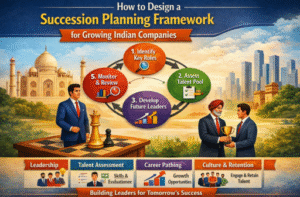
How to Design a Succession Planning Framework for Growing Indian Companies
A manufacturing firm in Pune recently lost its operations head to a competitor. Three months later, a

360-Degree Feedback vs Assessment Centres: Which Tool Drives Better Leadership Growth?
Ask ten L&D practitioners what they use to evaluate leadership potential and at least seven will mention