learncloudassignment.online

Table of Contents

Communication Skills for Mid-Level Managers: The 5 Conversations Every Manager Must Master

Home / Blog / Communication Skills for Mid-Level Managers: The 5 Conversations Every Manager Must Master
Author picture

Ask any senior leader what separates a good mid-level manager from a great one, and the answer almost always circles back to communication. Not communication in the generic sense of “being a good communicator,” but the specific ability to navigate the five or six critical conversations that define a manager’s effectiveness every single day.

Mid-level managers occupy the most communication-intensive role in any organization. They translate strategy into execution, deliver feedback that shapes careers, navigate disagreements across functions, advocate for their teams to senior leadership, and hold performance conversations that can make or break employee engagement. Every one of these interactions demands a different communication approach, a different set of skills, and a different level of emotional intelligence.

Yet in most Indian organizations, mid-level managers receive little to no structured development in the specific conversations that matter most to their success. They are promoted because they were excellent individual contributors, handed a team, and expected to figure out the communication part on their own. The result is predictable: clumsy feedback that demotivates instead of developing, upward communication that fails to influence, cross-functional conversations that create conflict instead of collaboration, and team meetings that waste time instead of building alignment.

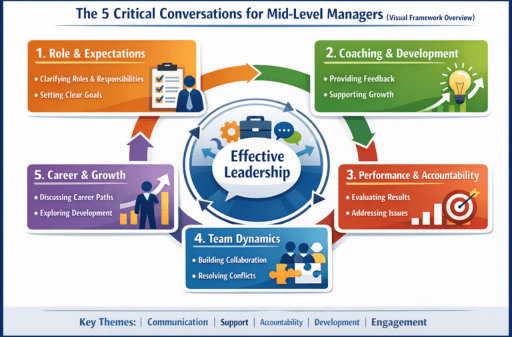
This article is a practical guide to the five conversations every mid-level manager must master to be effective. For each conversation type, we explore what makes it challenging in the Indian context, provide a structured framework for conducting it, identify the most common mistakes managers make, and offer specific techniques that can be practised and improved over time.
ableventure (27)
 

Conversation 1: The Development Feedback Conversation

Why It Matters

Development feedback is the single most impactful communication tool a manager has. When done well, it accelerates growth, builds trust, and drives performance. When done poorly, or not at all, it creates confusion, resentment, and stagnation. In Indian organizations, feedback conversations are often avoided entirely because of the cultural weight placed on relationships, respect for hierarchy, and the discomfort of direct criticism.

The result is a feedback vacuum. Employees do not know where they stand. Performance reviews become annual surprises. And managers silently accumulate frustration with underperformance until it explodes in an unproductive confrontation.

The Framework: SBI + Forward Focus

The SBI model (Situation, Behaviour, Impact) provides a clear, non-threatening structure for development feedback. But effective feedback does not stop at diagnosis. It must include a forward-looking element that gives the recipient a clear path for improvement.

  • Situation: Describe the specific situation where the behaviour occurred. “In yesterday’s client presentation…”
  • Behaviour: Describe the observable behaviour without interpretation or judgement. “…you moved through the pricing section very quickly without pausing for questions…”
  • Impact: Explain the impact of the behaviour. “…which meant the client’s concerns about cost were never addressed, and they left without clarity on ROI.”
  • Forward Focus: Collaboratively agree on what to do differently. “For the next presentation, what if we build in a dedicated Q&A pause after pricing? Would you like to practise that approach together?”

Common Mistakes in Indian Organizations

  • Sandwiching feedback so heavily that the message gets lost. The “positive-negative-positive” pattern is so overused that employees have learned to ignore the compliments and brace for the criticism.
  • Giving feedback about character rather than behaviour. “You are careless” is a character judgement. “The report contained three factual errors” is behavioural and actionable.
  • Waiting for the annual review. Feedback has maximum impact when delivered within 48 hours of the behaviour. Saving it for the performance review dilutes the message and removes the opportunity for timely improvement.
  • Avoiding upward feedback entirely. Mid-level managers need to learn to give constructive feedback to their own leaders, not just their direct reports.

Building genuine feedback capability requires sustained practice in realistic scenarios, not just a workshop. Communication skill development programmes that include structured role plays, live feedback practice sessions, and follow-up coaching provide the repetitive practice needed to make feedback conversations feel natural rather than forced.

Conversation 2: The Upward Influence Conversation

Why It Matters

Mid-level managers must regularly influence senior leaders: securing resources, advocating for their team’s priorities, presenting recommendations, pushing back on unrealistic expectations, and escalating issues that need attention. The ability to communicate upward with clarity, confidence, and strategic awareness is what separates managers who are seen as leaders from those who are seen as order-takers.

In Indian organizations, upward communication carries particular weight. Hierarchical norms, the respect due to seniority, and the political dynamics of organizational life all make upward influence conversations more complex. Many mid-level managers either avoid difficult upward conversations entirely or approach them in ways that are either too deferential (failing to communicate the real message) or too blunt (creating defensiveness in the senior leader).

The Framework: PREP for Upward Influence

  • Point: Lead with your recommendation or key message. Senior leaders are time-constrained. Do not bury the lead. “I recommend we delay the Q3 launch by four weeks.”
  • Reason: Provide the 2 to 3 strongest reasons that support your recommendation, framed in terms of business impact. “The testing team has identified two critical integration issues that, if unresolved, will cause system failures for our top-tier clients.”
  • Evidence: Support your reasons with specific data, examples, or credible references. “In the last release, a similar issue caused 12 hours of downtime for 340 enterprise accounts, resulting in 8 escalations to the CEO’s office.”
  • Plan: Offer a clear path forward. Senior leaders do not want to hear just problems; they want solutions. “I have a 4-week remediation plan that addresses both issues without impacting the Q4 timeline. Here is the detail.”

Common Mistakes

  • Starting with background context instead of the key message. Senior leaders lose patience when they cannot find the point.
  • Framing issues as complaints rather than business risks. “My team is overworked” is a complaint. “We are at risk of missing the delivery deadline because of a resource gap” is a business problem.
  • Not preparing for objections. Anticipate the two or three most likely pushback points and prepare concise responses.
  • Failing to follow up. An upward influence conversation is not over when the meeting ends. Written follow-up with clear action items and timelines signals professionalism and accountability.

Mastering upward influence requires understanding not just communication technique but also organizational dynamics. Leadership development programmes that combine communication frameworks with strategic thinking and stakeholder management skills equip mid-level managers with the complete toolkit for effective upward influence.


Equip Your Mid-Level Managers With Communication Skills That Drive Results

Conversation 3: The Cross-Functional Collaboration Conversation

Why It Matters

Mid-level managers spend a significant portion of their time working across functional boundaries: coordinating with other teams, resolving dependencies, negotiating timelines, and aligning priorities. These cross-functional conversations are often the most frustrating because neither party has direct authority over the other, goals may conflict, and both sides are under pressure from their own leadership.

In Indian organizations, cross-functional tension is often amplified by silo culture, competing departmental KPIs, and the tendency to escalate conflicts to senior leadership rather than resolving them at the managerial level.

The Framework: Interest-Based Negotiation

  • Separate positions from interests. “I need the data by Friday” is a position. “I need to present accurate forecasts to the board on Monday” is the underlying interest. Understanding interests opens up creative solutions that positions alone do not.
  • Acknowledge the other side’s constraints. Before pushing your own agenda, demonstrate that you understand their challenges. “I know your team is managing the audit cycle simultaneously, so I want to find a solution that works for both of us.”
  • Generate options collaboratively. Instead of presenting your solution and asking for agreement, brainstorm options together. “What if we scope down the data request to the three most critical metrics? Would that be feasible within your team’s bandwidth?”
  • Agree on specific commitments. Vague agreements produce missed expectations. Confirm who will do what, by when, and how progress will be communicated.

Cross-functional communication skills are best developed in environments that simulate the real complexity of organizational dynamics. Corporate training programmes that use case study simulations, cross-team role plays, and experiential exercises teach managers to navigate competing priorities without damaging relationships.

Conversation 4: The Performance Accountability Conversation

Why It Matters

Perhaps the most avoided conversation in any manager’s repertoire is the one that addresses sustained underperformance. Not a single missed deadline, but the pattern: consistently below expectations, repeated after feedback, and impacting the team’s morale and output.

Most mid-level managers in Indian organizations handle underperformance through one of two extremes. Either they avoid the conversation entirely, hoping the problem will resolve itself (it rarely does). Or they approach it with such harshness that the employee becomes defensive, the relationship breaks down, and the situation worsens. Both approaches fail because they do not separate the person from the performance issue.

The Framework: CLEAR Accountability

  • Clarify the expectation. Restate the specific performance standard that is not being met. “The role requires that client proposals are delivered within 5 business days of the initial briefing, with a quality score above 85%.”
  • Listen to understand. Before jumping to consequences, ask for the employee’s perspective. There may be legitimate barriers you are unaware of: unclear priorities, resource constraints, personal challenges, or skills gaps. “Help me understand what is making it difficult to meet this standard consistently.”
  • Explore solutions together. Based on what you hear, collaboratively identify what needs to change and what support the employee needs. “Would additional training on the proposal template help? Should we adjust the workflow to give you more prep time?”
  • Agree on a specific improvement plan. Define measurable milestones, a timeline, and how progress will be tracked. “Let us set a 60-day plan where we review proposal quality weekly. The target is 85% or above for 4 consecutive weeks.”
  • Reaffirm your investment in their success. Close the conversation with genuine support, not threat. “I want you to succeed in this role. This plan is designed to help you get there, and I am committed to supporting you through it.”

Understanding the behavioural patterns that drive underperformance helps managers design more targeted interventions. Behavioural assessments can reveal whether the root cause is a skill gap, a motivational issue, a role mismatch, or a behavioural pattern that requires coaching rather than training.

Conversation 5: The Team Alignment Conversation

Why It Matters

The most underrated communication skill for mid-level managers is the ability to create alignment within their team. This is not about running good meetings, although that is part of it. It is about creating a shared understanding of purpose, priorities, and expectations that enables the team to make good decisions independently, without the manager being involved in every conversation.

In Indian organizations, team alignment conversations often default to status update meetings: each person reports what they are working on, the manager nods, and everyone goes back to their desks. No strategic context is shared. No priorities are clarified. No trade-offs are discussed. The team has information about each other’s tasks but no understanding of how their work connects to the bigger picture.

The Framework: The Three Questions

Every effective team alignment conversation should address three questions:

  • Where are we going? What is the team’s purpose this quarter? What does success look like? What are the 2 to 3 things that matter most? This provides strategic context that helps every team member make better daily decisions.
  • Where are we now? What is our current reality? What is working well? Where are we off track? What obstacles are we facing? This requires honest assessment, not just optimistic reporting.
  • What do we need to do next? Based on where we are going and where we are, what are the specific actions, decisions, and trade-offs required this week? Who owns each action? What does each person need from others on the team?

Running this conversation effectively, creating psychological safety for honest input, managing diverse perspectives, synthesizing information, and driving toward clear commitments, is a complex communication skill that requires deliberate practice.

Teams function best when their alignment conversations are supported by a shared language of competencies and expectations. Professional development programmes that define competency frameworks for each role create the foundation for more productive team conversations about performance, growth, and collaboration.

The 5 Conversations: Quick Reference Comparison

Conversation

Framework

Key Skill

Biggest Mistake

Indian Context Challenge

Practice Method

Development Feedback

SBI + Forward Focus

Behavioural specificity

Avoiding feedback or making it personal

Relationship sensitivity, fear of offending

Structured role play with peer feedback

Upward Influence

PREP

Strategic framing

Burying the lead or complaining

Hierarchical deference, fear of pushback

Simulated leadership presentations

Cross-Functional Collaboration

Interest-Based Negotiation

Perspective taking

Positional bargaining or escalating

Silo culture, competing KPIs

Cross-team case study simulations

Performance Accountability

CLEAR

Balanced directness and empathy

Avoidance or harshness

Reluctance to confront, loyalty dynamics

Coaching with real scenario debrief

Team Alignment

The Three Questions

Strategic synthesis

Defaulting to status updates

Hierarchical meeting dynamics

Facilitation practice with observer feedback

Get Our Communication Skills Training Brochure for Mid-Level Managers

Why Generic Communication Training Fails for Mid-Level Managers

Most communication skills training programmes suffer from one or more of these design flaws:

  • Too broad. They try to cover everything from email writing to presentation skills to conflict resolution in a single two-day workshop. Breadth without depth produces awareness without capability.
  • Too theoretical. Participants learn about communication models but never practise applying them in realistic, pressure-filled scenarios that mirror their actual work.
  • No Indian context. Frameworks designed for Western workplace norms do not account for the nuances of hierarchy, indirect communication, and relationship-driven cultures that shape how communication works in Indian organizations.
  • No follow-up. A two-day workshop without reinforcement produces a short-term energy boost but no lasting behaviour change. Managers return to their desks and default to old patterns within weeks.

Effective communication development requires a sustained approach that sequences learning over time. Learning journeys designed specifically for communication skill development spread learning across 8 to 12 weeks, with each phase focusing on one conversation type, followed by real-world practice assignments and coaching feedback before moving to the next.

Building Communication Capability: A Practical Approach for Organizations

Step 1: Assess Current Communication Patterns

Before designing training, understand where the gaps actually are. Use behavioural assessments and 360-degree feedback to identify specific communication patterns that are helping or hindering managerial effectiveness. This data ensures that development efforts target the right conversations rather than covering everything generically.

Step 2: Design Conversation-Specific Training

Build training around the specific conversation types that matter most for your organization. Corporate training programmes that use the TRAIN framework (Tailored, Result-driven, Accomplished trainers, Interactive, Nimble enablement) ensure that communication training is customized to your organizational context, interactive in design, and supported by post-programme reinforcement.

Step 3: Reinforce Through Practice and Coaching

Communication skills improve through repetition with feedback, not through knowledge acquisition. Build regular practice opportunities into the work environment: peer coaching partnerships, monthly skill practice sessions, manager-led feedback conversations, and structured reflection exercises.

Step 4: Measure Behaviour Change

Track whether communication training is producing on-the-job behaviour change, not just positive training feedback. Learning assessments conducted at 30, 60, and 90 days post-training provide objective data on whether the target conversation skills are being applied in practice.

Step 5: Scale Through Digital Reinforcement

Use e-learning solutions to deliver pre-training preparation, post-training micro-learning nudges, and just-in-time reference materials that reinforce conversation frameworks. Digital reinforcement extends the impact of live training and ensures that managers have access to frameworks and tools whenever they need them.

Generic Communication Training vs Conversation-Specific Development: A Comparison

Dimension

Generic Communication Training

Conversation-Specific Development

Content Focus

Broad coverage: email, presentation, listening, conflict, persuasion

Deep focus: 5 critical conversations that drive managerial impact

Practice Design

Generic role plays with fictional scenarios

Realistic simulations based on actual workplace challenges

Cultural Relevance

Often based on Western communication norms

Adapted for Indian workplace dynamics: hierarchy, relationship norms, indirect communication

Duration

1 to 2 day workshop (event-based)

8 to 12 week journey with phased learning and reinforcement

Manager Involvement

None

Managers briefed as reinforcement partners

Measurement

Post-training satisfaction scores

Behaviour change at 30, 60, 90 days through observation and assessment

Knowledge Retention at 90 Days

10 to 20%

60 to 75% with structured reinforcement

Behaviour Change Rate

Less than 15%

60 to 70% with sustained practice and coaching

The Organizational Context: Culture Shapes Communication

Even the best communication training will underperform if the organizational culture works against the behaviours being developed. A manager trained in giving development feedback will not practise it if the culture punishes honest feedback. An upward influence programme will fail if the culture penalizes people who challenge senior leaders.

This is why progressive organizations pair communication development with broader culture transformation initiatives that create an environment where open communication, constructive feedback, and cross-functional collaboration are valued, modelled by leaders, and reinforced through systems and rewards.

Where organizational structures, incentives, or processes are actively blocking effective communication, OD consulting interventions can diagnose the systemic barriers and design structural changes that support the communication behaviours being developed through training.

The Bottom Line

The five conversations outlined in this guide are not abstract communication principles. They are the practical, daily interactions through which mid-level managers shape team performance, influence organizational decisions, build cross-functional relationships, and drive accountability. Mastering these conversations does not happen through a one-time workshop. It requires sustained practice, structured feedback, and an organizational environment that supports open, effective communication.

Organizations that invest in developing these specific conversation skills in their mid-level managers see measurable improvements in team engagement, cross-functional collaboration, performance management effectiveness, and leadership pipeline strength.

If you are ready to build communication capability that goes beyond generic training and targets the conversations that actually matter, explore Able Ventures’ communication skill development programmes and discover how conversation-specific development can transform the effectiveness of your managerial cadre.

Connect With Our Training Design Experts Today!

Frequently Asked Questions

What are the most important communication skills for mid-level managers?

The five most critical communication skills for mid-level managers are: delivering development feedback that drives growth, influencing senior leadership effectively, navigating cross-functional collaboration conversations, conducting performance accountability discussions, and creating team alignment. These are the conversations that most directly impact a manager’s effectiveness and their team’s performance.


Why do generic communication skills workshops fail to produce lasting results?

Generic workshops fail for four main reasons: they try to cover too many topics without depth, they rely on theory rather than realistic practice, they do not account for Indian workplace dynamics like hierarchy and relationship norms, and they have no post-training reinforcement. A two-day workshop without follow-up typically results in less than 15% behaviour change at 90 days.


How do you develop communication skills in managers who are resistant to feedback?

Start with a behavioural assessment to build self-awareness about current communication patterns. Resistance often stems from a lack of awareness rather than unwillingness. Then use structured learning journeys that build skills progressively, starting with lower-stakes conversations before advancing to more challenging ones. Peer coaching partnerships, where managers practise with colleagues in a safe environment, also reduce resistance more effectively than classroom instruction alone.


How long does it take to develop strong communication skills in mid-level managers?

With a structured approach, managers typically show measurable improvement within 8 to 12 weeks. However, embedding communication skills as habitual behaviour takes 3 to 6 months of sustained practice with reinforcement. The key is a learning journey approach that sequences skill building, real-world application, and feedback over time, rather than expecting a single workshop to produce lasting change.


Can communication skills training be delivered through e-learning alone?

Communication skills are inherently interpersonal, so e-learning alone is insufficient for building capability. However, e-learning plays an important complementary role: it is excellent for delivering pre-training foundational content, introducing frameworks, providing post-training micro-learning reinforcement, and offering just-in-time reference materials. The most effective approach blends e-learning with live practice sessions, coaching, and peer learning.


How should communication skills training be adapted for Indian workplace dynamics?

Indian workplaces require specific adaptations: feedback frameworks should account for relationship sensitivity and indirect communication norms. Upward influence training should address hierarchical deference without encouraging submissiveness. Cross-functional collaboration training should explicitly address silo dynamics common in Indian organizations. And all practice scenarios should use locally relevant contexts, examples, and language patterns.


How do we measure whether communication training is working?

Effective measurement goes beyond post-training satisfaction scores. Track knowledge retention through delayed assessments at 30 and 60 days. Measure behaviour application through 360-degree feedback from direct reports, peers, and supervisors. Monitor team-level metrics like engagement scores, collaboration effectiveness, and performance review quality. These indicators collectively show whether communication training is translating into observable workplace behaviour change.


What role does organizational culture play in communication effectiveness?

Culture has a profound impact. If the organizational culture punishes honest feedback, discourages upward challenge, or rewards silo behaviour, even well-trained managers will default to old communication patterns. Effective communication development must be paired with cultural support: leadership modelling, recognition systems, and structural changes that make open communication safe and valued.


Can EZYSS or other assessment tools help identify communication development needs?

Yes. Gamified assessments like EZYSS provide rich behavioural data about how individuals make decisions, respond to pressure, and interact in team settings. This data can reveal specific communication patterns such as conflict avoidance, directive communication tendencies, or difficulty adapting communication style to different audiences, enabling highly targeted development planning.


What is the ROI of investing in communication skills development for mid-level managers?

Organizations that systematically develop communication skills in their mid-level managers typically see improvements in employee engagement scores (managers are the primary driver of engagement), reduction in voluntary attrition (poor management communication is a top driver of turnover), improved cross-functional project success rates, faster decision-making, and stronger leadership pipeline quality. While these outcomes develop over 6 to 12 months, the compound effect on organizational performance is substantial and sustained.

Recent Blogs

Scroll to Top