
Table of Contents
Quarter-End Reflection: 12 Questions Every CHRO Should Ask About Their Organisation’s People Capability

- March 31, 2026
- Dinesh Rajesh
- 12:42 pm
Today is the last day of Q1 2026. Across India, finance teams are closing their books, sales leaders are reconciling their pipelines, and operations heads are reviewing their delivery metrics. The quarter’s performance is being quantified, explained, and actioned.
For CHROs, the quarter-end review deserves the same rigour. Not the compliance review: whether policies are current, whether onboarding is complete, whether appraisals have been filed. The strategic review: whether the organisation’s people capability is genuinely moving in the direction the business needs it to move, whether the investments made in the first quarter of the year are building what they were designed to build, and whether the talent risks and gaps that will shape performance in Q2, Q3, and Q4 are visible and being managed.
The most effective CHROs treat this reflection not as an administrative close-out but as a structured diagnostic: a set of questions that cut through the activity data to reach the capability reality underneath. The 12 questions in this article are drawn from the strategic review conversations that Able Ventures conducts with CHROs and HR leadership teams through its organisation development consulting work. They are not designed to have easy answers. They are designed to surface the honest picture of where people capability stands at the end of the first quarter, and to identify the most important actions for Q2.
How to Use These Questions
These 12 questions are organised across four capability domains: Leadership Pipeline and Succession, Learning and Development Effectiveness, Culture and Organisational Health, and Talent Assessment and People Data. Each question is followed by the context that makes it strategically useful and the data or evidence sources that a CHRO should consult when answering it honestly.
The questions are most valuable when answered with evidence rather than impression. If the honest answer to any of them is ‘I am not sure’ or ‘we do not have that data,’ that itself is a significant Q2 signal. Not knowing is not a neutral position. It is an indication of where measurement infrastructure needs to be built.
Domain 1: Leadership Pipeline and Succession
Question 1 For each of your organisation’s 10 most critical roles, can you name a successor who is genuinely ready within 12 months? Not a name on a succession chart produced during the last talent review. A person whose capability has been objectively assessed against the role’s competency requirements, whose readiness has been classified based on evidence, and who is actively engaged in a development plan targeting their specific gaps. If the honest answer is no for more than three of your ten critical roles, your succession risk is higher than it should be at this point in the year. The action is not to update the chart. It is to deploy the assessment infrastructure that produces real readiness data. |
Question 2 Has any critical role in your organisation changed significantly due to strategic shifts in Q1, and has the succession framework been updated to reflect those changes? Succession planning built around last year’s role definitions is measuring the wrong target. If Q1 has seen a strategic pivot, a technology implementation, or a significant market shift that has materially changed what effective performance in a critical role looks like, the competency profiles and readiness assessments attached to those roles need to be reviewed. A succession framework that is not updated when the business changes is providing false confidence. |
Question 3 What proportion of your high-potential employees identified in the last talent review have received a high-visibility stretch assignment in Q1? High-potential identification without stretch opportunity allocation is a classification exercise, not a development intervention. If your HiPo list exists but the people on it are doing the same work in Q1 that they were doing in Q4, the pipeline is not moving. The research on what accelerates senior leadership readiness consistently identifies stretch assignments as the primary mechanism. If fewer than half of your identified HiPos have received a meaningful stretch opportunity in Q1, the development architecture is missing its most important lever. |
Is Your Leadership Pipeline Built on Evidence or on Assumptions?
Domain 2: Learning and Development Effectiveness
Question 4 Of the training programmes delivered in Q1, for how many can you provide evidence of behaviour change in participants three months after completion? Training completion rates and satisfaction scores are the measurement equivalent of counting how many people attended a meeting rather than whether anything was decided. If you cannot point to specific evidence of changed on-the-job behaviour for the programmes delivered in Q1, you are measuring activity rather than impact. The BCG and WFPMA research with 7,000 HR leaders for 2026 identifies connecting people efforts directly to business outcomes as the defining priority for CHROs this year. Behaviour change evidence is the bridge between L&D activity and business outcome. |
Question 5 Do your managers know what capability gaps exist in their teams, based on assessment data rather than their own observation? Manager observation of team capability is a useful but unreliable primary data source. It reflects what the manager has seen, which is shaped by the work they have assigned, the relationships they have built, and the biases they bring to performance evaluation. If your managers are making development investment decisions based only on their own impression, a significant portion of those decisions will be misdirected. A pre-training assessment or structured capability baseline, produced before development plans are written rather than after, changes the quality of those decisions fundamentally. |
Question 6 For your largest L&D investment in Q1, what was the pre-training capability baseline that justified that investment and how will you measure whether it has moved? Every significant training investment should have a clear answer to three questions before the training runs: what specific capability gap is this designed to close, what is the current baseline on that gap, and what evidence will confirm that the gap has narrowed by a defined amount within a defined timeframe. If any one of those three questions does not have a specific answer for your Q1 flagship programme, you are spending without the ability to demonstrate return. In the current environment, where the pressure on L&D budgets is as high as it has ever been, this is a governance risk as much as a measurement gap. |
Domain 3: Culture and Organisational Health
Question 7 Do you have specific, observable evidence that the culture behaviours your organisation committed to building are being demonstrated differently today than they were on January 1? A values refresh, a culture narrative relaunch, or a town hall speech is not evidence of culture change. Culture change is evidenced by observable shifts in how leaders behave in meetings, how decisions are made and communicated, how mistakes are handled, and how concerns are raised and responded to. If your Q1 culture measurement consists of an engagement survey that shows a two-point improvement, you are not measuring culture. You are measuring sentiment. The organisations that make genuine progress on culture in 2026 are those with behavioural measurement infrastructure that tracks what people actually do, not what they say about how they feel. |
Question 8 Is there a specific team, function, or layer of the organisation where culture health is significantly below the organisational average, and do you know why? Organisation-wide culture averages mask the subculture variation that is often the most actionable data in the culture picture. A high average engagement score can coexist with a specific function or geography that is operating in ways entirely inconsistent with the organisational values, if the population is small enough and the reporting aggregate enough. Segmented culture data, by function, region, manager, and tenure, is what gives the CHRO the specificity needed to direct culture intervention resources where they will have the most impact rather than spreading them evenly across a healthy and an unhealthy population simultaneously. |
Question 9 Which of your senior leaders is most visibly role-modelling the culture the organisation is trying to build, and which is most visibly contradicting it? Senior leader behaviour is the most powerful determinant of what the culture actually is, regardless of what the values statement says. Every organisation has leaders whose behaviour is genuinely consistent with the stated culture and leaders whose behaviour is not. If the CHRO cannot name both categories with reasonable confidence, the organisation is not tracking the most consequential cultural variable available to it. The answer to this question does not require a complex measurement system. It requires structured listening, honest 360-degree feedback, and the willingness to hold the data clearly. |
Domain 4: Talent Assessment and People Data
Question 10 Can you describe the capability profile of your organisation’s workforce in 2026 versus what it needs to be in 2028, and how large is the gap? Strategic workforce planning is not a headcount exercise. It is a capability exercise. The question is not how many people the organisation will need in two years. It is what capability those people will need to have, and what the current workforce’s profile looks like against that requirement. CHROs who cannot describe this gap with reasonable specificity are making people development investment decisions without a defined target. The SHRM research on 2026 CHRO priorities identifies this capability-forward orientation as a defining characteristic of the most strategically effective HR functions this year. |
Question 11 Of the employees who left the organisation in Q1, how many were assessed as high-potential or high-performing, and what does their exit data tell you about which capability-related risk factors are still present? Voluntary attrition data is one of the richest diagnostic resources available to a CHRO and one of the most consistently under-analysed. The performance and potential rating of departing employees tells you whether you are losing the people you can least afford to lose. The reasons they give for leaving, when gathered through honest exit conversations rather than compliance exit interviews, tell you which organisational conditions are driving them out. If Q1 attrition was concentrated among high-performing or high-potential employees, and if the reasons they gave included insufficient development opportunities, lack of sponsorship, or a gap between stated values and lived experience, those are Q2 intervention signals that deserve immediate attention. |
Question 12 If the CEO asked you tomorrow to describe the state of your organisation’s people capability in three sentences, what would those sentences be and how confident are you in the data behind them? This is the question that integrates all the others. The CHRO who can answer it clearly, specifically, and with genuine confidence in the evidence behind the answer is operating as a strategic people leader. The CHRO who finds the question difficult to answer is receiving a signal about where to invest in Q2: not in more training programmes or culture initiatives, but in the foundational measurement infrastructure that makes confident, data-driven people leadership possible. The BCG research with the World Federation of People Management Associations identifies this exact capacity, the ability to deliver business value through connected people strategy, as the number one power move for CHROs in 2026. |
How Many of These 12 Questions Can You Answer with Evidence Today?
Reading Your Q1 Picture: A Reflection Guide
These 12 questions are not designed to produce a score. They are designed to produce clarity. After working through them honestly, most CHROs will find that their answers fall into three categories.
Questions with Clear, Evidence-Based Answers
These are the domains where the organisation’s people capability infrastructure is working. The measurement systems, the development frameworks, the assessment tools, and the review cadences are in place and producing usable insight. These are the foundations to build on in Q2.
Questions with Impressionistic Answers Based on Judgement Rather Than Data
These represent domains where the CHRO has a view, but that view rests on anecdote, relationship, or instinct rather than on objective evidence. The Q2 priority here is not to improve the underlying capability immediately but to build the measurement infrastructure that converts impression into evidence. Decisions based on impression are more expensive over time than the cost of building the measurement infrastructure that replaces them.
Questions Where the Honest Answer Is ‘I Do Not Know’
These are the most valuable findings of the quarter-end reflection. They represent the specific capability visibility gaps that carry the highest risk of producing an unpleasant surprise in Q2, Q3, or Q4. A succession gap you know about is manageable. A succession gap you discover when a critical role opens unexpectedly is a crisis. A culture problem you are tracking is improvable. A culture problem you discover through an attrition spike is already expensive. The ‘I do not know’ answers are the Q2 investment priorities. Explore how Able Ventures’ integrated approach to organisation development consulting and behavioural assessment helps CHROs convert their most consequential ‘I do not know’ answers into clear, evidence-based capability pictures.
Translating Q1 Reflection into Q2 Action
The value of a quarter-end reflection is not in the questions themselves but in the decisions it produces. A structured Q1 review should generate a short, prioritised list of Q2 actions. These are the most common high-priority actions that emerge from this kind of reflection for Indian CHROs at this point in the year.
- Deploy objective capability assessment across any population where development investment decisions are currently being made on manager observation alone
- Audit the succession readiness classifications for the organisation’s ten most critical roles against the actual competency profiles of those roles as they exist today, not as they were defined twelve months ago
- Identify the two or three leadership behaviours that most directly drive the culture outcomes the organisation is trying to achieve and build a specific measurement and accountability mechanism around those behaviours for Q2
- Review Q1 training investment against pre-training baseline data and post-training behaviour change evidence; where neither exists for a significant programme, design the measurement infrastructure before committing Q2 budget
- Schedule honest exit conversations with the two or three most capable people who left the organisation in Q1 and extract the specific capability-related signals from those conversations
- Present the Q1 people capability picture to the CEO and board with the same specificity and confidence as the Q1 financial performance picture, and identify the gaps between current capability and the capability required for the year’s strategic objectives.
The Questions Are the Practice
The 12 questions in this article are not a compliance checklist to be worked through mechanically and filed. They are a diagnostic practice: a structured way of looking at the organisation’s people capability with the same honest, evidence-based rigour that the business applies to its financial and operational performance.
The CHROs who ask these questions quarterly, who sit with the uncomfortable answers rather than rationalising them away, and who use the findings to drive specific, prioritised actions in the subsequent quarter are the ones whose organisations build genuine people capability advantage over time. That advantage is not visible in any single quarter’s data. It is visible in the pattern: in successors who are ready when they are needed, in managers who are developing rather than just directing their teams, in cultures that are measurably becoming what they aspired to be, and in workforces that are equipped for the strategy the organisation is trying to execute.
The practice starts with the question. The advantage comes from asking it honestly, every quarter, and acting on the answer. As you begin Q2, Able Ventures invites you to explore how its integrated approach to organisation development consulting, behavioural assessment, and leadership development can help your organisation answer these questions with confidence rather than impression, with evidence rather than assumption, and with the specificity that strategic people leadership requires.
Start Q2 with Clarity on Your Organisation's People Capability

Dinesh Rajesh
Frequently Asked Questions
The quarterly rhythm of business performance review applies as much to people capability as it does to financial and operational performance. People capability is a leading indicator of business performance: the capability gaps visible today predict the performance gaps that will emerge in three to six months. A CHRO who reviews people capability only annually is operating with a significant lag in the most consequential data they are responsible for.
The most useful data sources are: succession readiness classifications updated against objective assessment data, training impact evidence from Q1 programmes including behaviour change indicators rather than just completion rates, segmented culture and engagement data by function, region, and management layer, attrition data segmented by performance and potential rating, and individual capability profiles from behavioural assessments deployed in Q1. Where these data sources do not exist, their absence is itself the most important finding of the review.
A standard HR metrics review covers operational indicators: headcount, attrition rates, training completion percentages, time-to-hire, and cost-per-hire. These are important but they are activity and efficiency metrics. A people capability review asks whether the organisation’s workforce is genuinely equipped to execute its strategy, whether the leadership pipeline is adequate for its succession needs, whether the culture is operating in ways consistent with the organisation’s stated values, and whether the development investment being made is producing measurable capability change. These are strategic questions, and they require different data to answer.
The most effective presentations connect people capability data directly to business performance outcomes and strategic risk. Rather than presenting HR activity metrics, the CHRO presents the capability baseline against the capability requirement, the succession coverage against the organisational risk profile, and the culture health data against the cultural prerequisites for the year’s strategic objectives. The frame is always: here is what the business needs from its people to execute the strategy, here is where people capability currently stands against that requirement, and here are the specific investments and interventions needed to close the gap.
The most consistently surfaced finding is the absence of objective, evidence-based capability data for the population where the most consequential development decisions are being made. CHROs discover that their succession framework is built on manager nominations rather than on assessed competency profiles, that their training investment decisions are made without pre-training capability baselines, and that their culture assessment consists of annual engagement scores rather than behavioural metrics. These are not failures of effort or intent. They are infrastructure gaps, and they are addressable with the right measurement architecture.
Quarterly structured reviews of the kind described in this article represent the minimum appropriate cadence for an organisation that is serious about managing people capability as a strategic variable. Within quarters, specific capability domains should have their own review rhythms: succession readiness should be updated against new assessment data at least semi-annually, leadership behaviour alignment should be tracked monthly or quarterly through structured 360-degree feedback, and training impact should be assessed at 60 and 90 days post-programme. Able Ventures builds these cadences into the learning journeys and organisation development engagements it designs for Indian enterprises, because measurement cadence is as important as measurement methodology.
The diagnostic identifies what needs to change and prioritizes where to intervene. Interventions are then designed based on the diagnostic findings, which might include targeted corporate training for identified capability gaps, leadership development programmes for pipeline acceleration, culture transformation through Culture NXT, learning journeys for sustained capability building, communication skills development, or structural/process changes recommended through the OD diagnostic. The key is that every intervention traces back to a diagnostic finding.
Recent Blogs
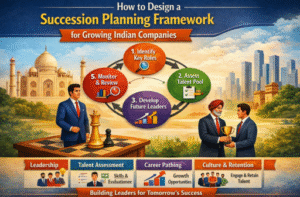
How to Design a Succession Planning Framework for Growing Indian Companies
A manufacturing firm in Pune recently lost its operations head to a competitor. Three months later, a

360-Degree Feedback vs Assessment Centres: Which Tool Drives Better Leadership Growth?
Ask ten L&D practitioners what they use to evaluate leadership potential and at least seven will mention

The OD Consulting Toolkit: 7 Diagnostic Frameworks Every HR Leader Should Understand
Every experienced doctor knows that treatment without diagnosis is malpractice. You do not prescribe medication based on