Proven Results: Measuring Success with the Kirkpatrick Model
Organizations today invest significantly in learning and development; but one critical question continues to surface in boardrooms and leadership reviews:
Your blog category
Organizations today invest significantly in learning and development; but one critical question continues to surface in boardrooms and leadership reviews:
Every year, Indian organizations collectively invest thousands of crores in employee training. Yet a persistent question haunts boardrooms and HR leadership meetings across the country: where is the return?
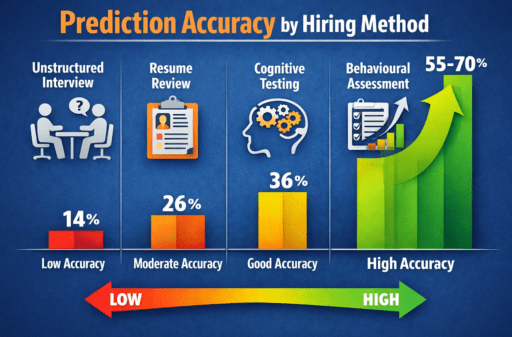
Hiring the wrong person is expensive. Studies suggest that a bad hire can cost an organization anywhere from 30% to 200% of the employee’s annual salary when you factor in recruitment costs, onboarding time, lost productivity, and the eventual cost of replacement. In India’s competitive talent market, where attrition rates in sectors like IT, BFSI, and retail regularly exceed 15 to 20%, the pressure to get hiring right has never been higher.
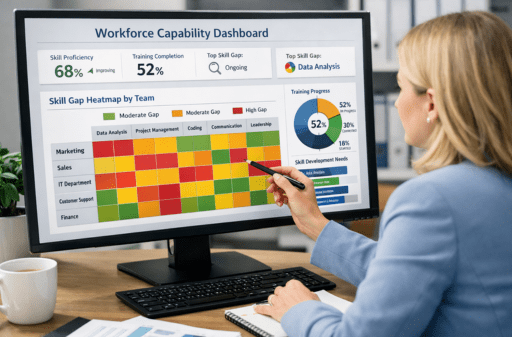
Every HR leader in India has faced this situation at least once. Performance reviews feel inconsistent. Promotion decisions spark whispers of favouritism. Training budgets get spent without anyone knowing whether the right skills are being built. The root cause, more often than not, is the same: the organization lacks a clear, actionable competency framework.
The frameworks that once guided organizational strategy no longer apply. The BANI world, characterized by conditions that are Brittle, Anxious, Nonlinear, and Incomprehensible, demands fundamentally different approaches to leadership and decision making under uncertainty. Organizations face disruptions that arrive without warning, cascade unpredictably, and resist conventional analysis.
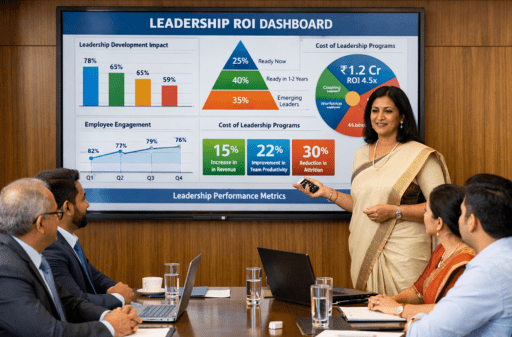
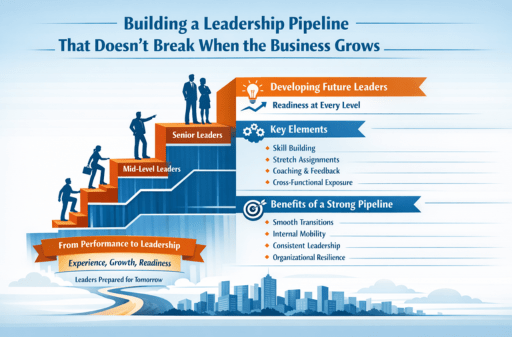
Leadership is not a soft capability. It is a decisive business variable. Organizations with strong leadership pipelines outperform peers not because they work harder, but because their leaders think better, lead people more effectively, and execute with consistency.
Yet, despite heavy investment in leadership training and leadership development programs, many organizations still struggle with stalled initiatives, disengaged teams, and fragile succession pipelines. The issue is not a lack of effort. It is a lack of integration.
Professional communication skills are no longer a “soft skill.” They are a core business capability.
In every organisation, outcomes are shaped not just by what people know, but by how clearly they think, articulate, listen, and align. Effective communication at work determines how quickly decisions are made, how confidently teams execute, and how well organisations adapt under pressure. Where communication breaks down, performance follows.
Customer service excellence is widely acknowledged as a business priority. Yet in many organisations, it remains an aspiration rather than a consistently delivered reality. Leaders speak about customer centricity, but frontline teams are often constrained by rigid processes, limited authority, and fragmented capability building.
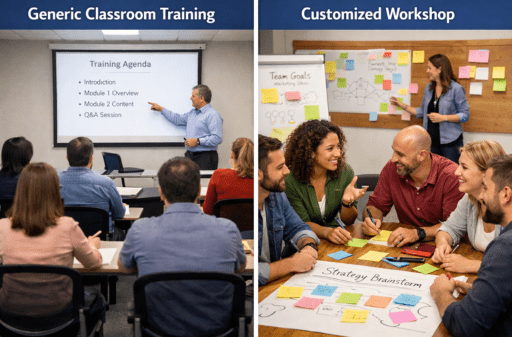
Organizations today are operating in conditions where roles evolve faster than job descriptions, and skills lose relevance far sooner than expected. Yet many learning and development strategies continue to rely on standardized programs — well-designed, well-intentioned, and often well-attended.
As organizations grow and scale, challenges in team performance management rarely stem from a lack of talent. More often, they emerge from gaps in execution, decision-making, and alignment at the managerial level. It is mid-level managers—those responsible for translating strategy into daily action—who ultimately determine whether teams perform consistently or fall short.