learncloudassignment.online

Blog

Your blog category

ableventure (83)
Blog

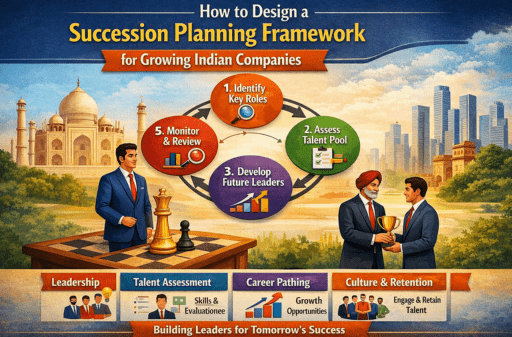
How to Design a Succession Planning Framework for Growing Indian Companies

A manufacturing firm in Pune recently lost its operations head to a competitor. Three months later, a Bengaluru-based fintech startup saw its VP of Product resign without notice. In both cases, the organisations scrambled. Projects stalled. Morale dipped. The hiring process took longer than expected, and institutional knowledge quietly walked out with the people who left.

ableventure (80)
Blog

Why Professional Development Plans Fail Without Behavioural Data (and How to Fix Yours)

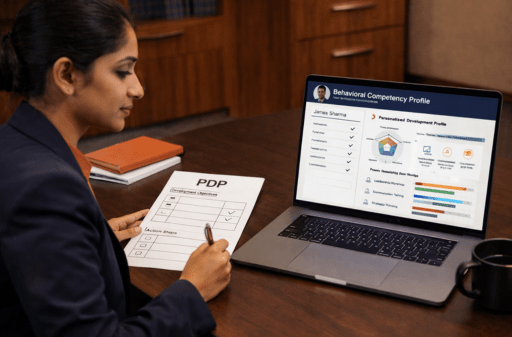
Every Indian organisation above a certain size has a professional development plan process. HR sends out a template at the start of the financial year or appraisal cycle. Managers sit down with their team members for a development conversation, usually after the performance review is done and the rating is already determined. Some goals are written down. A training programme or two is recommended. The form is submitted to HR and filed in the HRMS. A year later, the same process repeats.

ableventure (79)
Blog

How to Build a Succession Planning Framework That Actually Works (Not Just a Chart on Paper)

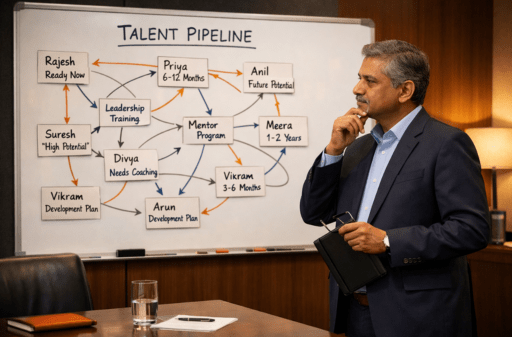
Almost every large Indian organisation has a succession plan. Very few have a succession planning framework. The distinction is more than semantic. A succession plan is a document that lists names against roles. It is produced during a talent review cycle, filed somewhere that leaders can point to it during a board meeting, and then largely ignored until the next cycle begins. A succession planning framework, by contrast, is a continuous, data-driven system that identifies critical roles, assesses the readiness of potential successors against objective capability benchmarks, drives personalised development for those successors, and updates in real time as the organisation and its people evolve.

ableventure (78)
Blog

Conflict Resolution Training for Indian Workplaces: Why Generic Western Models Fall Short

Here is a scene that will be familiar to most HR managers in India. A conflict resolution training is conducted for managers. The framework used is something well-known, perhaps the Thomas-Kilmann model, perhaps interest-based relational negotiation, perhaps a communication skills module developed by a global training vendor. The facilitator is engaging, the workbook is professional, and the feedback forms return reasonable scores. Three months later, the same patterns of unresolved tension, passive avoidance, and simmering interpersonal friction are exactly where they were before.

ableventure (77)
Blog

The Complete Guide to Designing a Corporate University for Indian Enterprises

At some point in the growth of every Indian enterprise, the organisation outgrows its training calendar. What used to work as a mix of vendor-led workshops, compliance modules, and ad hoc skill sessions starts to produce diminishing returns. The organisation is spending more on learning than ever before, yet the business still lacks the capabilities it needs, leaders are not developing fast enough, and there is no coherent story about where the workforce is headed.

ableventure (76)
Blog

How EZYSS Gamified Assessments Help Indian Organizations Identify High-Potential Talent Early

Every organisation in India has people inside it right now who are capable of operating two or three levels above where they currently sit. The challenge is identifying them before someone else does, before they leave because they did not see a path forward, or before a critical leadership gap opens up and there is nobody ready to step into it. The cost of getting this wrong is not theoretical. It shows up in failed promotions, in expensive external hires who underperform against expectations, in succession plans that exist only on paper, and in the steady attrition of people who felt their potential was invisible to the organisation.

ableventure (75)
Blog

Building Psychological Safety at Work: A Practical Framework for Indian Leaders

There is a particular kind of silence that sits in many Indian boardrooms and team meetings. It is not the silence of people who have nothing to say. It is the silence of people who have calculated, consciously or not, that saying what they actually think carries a cost they are not willing to pay. This calculation happens thousands of times a day across organisations, and its cumulative effect on innovation, decision quality, and talent retention is enormous.

ableventure (74)
Blog

Pre-Training Assessment: The Step Most Indian Companies Skip (and Why It Costs Them Crores)

There is a pattern that plays out with remarkable consistency inside Indian organisations. A business unit flags a performance problem. HR or L&D responds by scheduling a training programme. A vendor is engaged, a two-day workshop is delivered, attendance is tracked, a feedback form is collected, and the matter is considered closed. Three months later, the original problem has not moved.

Scroll to Top